
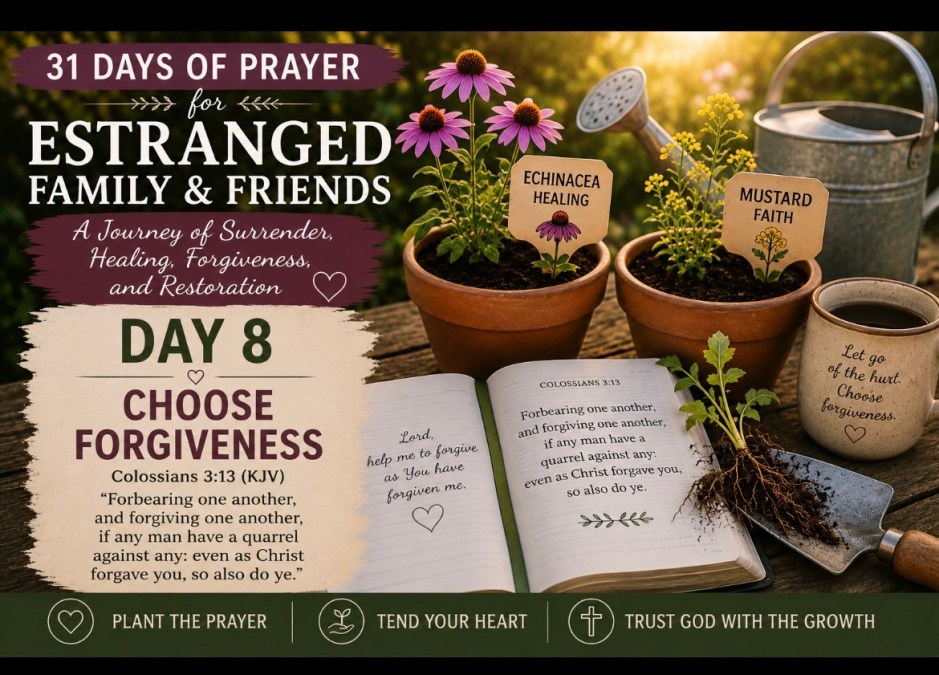
Scripture — Colossians 3:13 KJV
“Forbearing one another, and forgiving one another, if any man have a quarrel against any: even as Christ forgave you, so also do ye.”
Welcome back to 31 Days of Prayer for Estranged Family and Friends—a journey of surrender, healing, forgiveness, and restoration.
Yesterday, we completed our first week together.
For seven days, we’ve been learning to surrender what we cannot fix.
We’ve placed the person we love into God’s hands.
We’ve trusted what we cannot see.
We’ve asked God to search our hearts.
We’ve surrendered arguments and pieces of the past.
We’ve brought Him our grief.
And finally, we became still and remembered:
He is God.
Today we begin Week Two: Healing the Heart.
And we’re beginning with something that can be one of the hardest parts of a broken relationship.
Forgiveness.
Our Scripture today is Colossians 3:13:
“Forbearing one another, and forgiving one another, if any man have a quarrel against any: even as Christ forgave you, so also do ye.”
Today we’re not going to pretend the hurt didn’t happen.
We’re not going to call something good that was wrong.
We’re simply going to begin asking God:
“Can You help me forgive?”
When Forgiveness Feels Impossible
There are some hurts that are relatively easy to release.
And then there are others.
Words that changed a relationship.
Betrayals we never expected.
False accusations.
Rejection.
Years of silence.
Perhaps someone walked away without ever giving you the opportunity to explain.
Or maybe the pain isn’t one enormous event.
Maybe it’s hundreds of little wounds accumulated over years.
When someone says, “You need to forgive,” it can sometimes sound as though they’re asking you to pretend none of it mattered.
But biblical forgiveness doesn’t require us to say:
“It didn’t hurt.”
It doesn’t require us to say:
“What happened was acceptable.”
Forgiveness begins with truth.
It did hurt.
It did matter.
And I don’t want this hurt to control my heart forever.
What Forgiveness Is—and What It Isn’t
I think this distinction is especially important when we’re praying about estranged relationships.
Forgiveness and reconciliation are related, but they are not identical.
Forgiveness is something we can begin before God even if the other person isn’t ready to reconcile.
Reconciliation involves relationship.
It generally requires truth, willingness, and participation from both sides.
Trust may also need to be rebuilt slowly.
So choosing forgiveness today doesn’t necessarily mean you need to call someone.
It doesn’t automatically mean restoring access that would be unwise.
It doesn’t mean abandoning healthy boundaries.
And it doesn’t mean forgetting everything you’ve learned.
Forgiveness means we’re choosing not to make bitterness our home.
We’re placing judgment into God’s hands rather than allowing resentment to continually consume ours.
“Even as Christ Forgave You”
Colossians 3:13 gives us the reason:
“…even as Christ forgave you, so also do ye.”
That’s humbling.
Because suddenly I’m not only looking at what someone else owes me.
I’m remembering what I have been forgiven of.
The grace God has shown me.
The patience He has had with me.
The times I have failed.
The things I have needed forgiveness for.
That doesn’t make another person’s wrongdoing less wrong.
It simply changes the position from which I look at them.
Instead of standing only as someone who has been wounded, I remember:
I am also someone who has received mercy.
And because I have received mercy, I want to become someone through whom mercy can flow.
Not because the other person has earned it.
But because Christ has shown mercy to me.
Forgiveness May Begin Before the Feeling Comes
Maybe you’re listening today and thinking:
“I want to forgive, but I don’t feel forgiving.”
That’s okay.
Sometimes forgiveness begins as a decision before it becomes a feeling.
You may pray today:
“Father, I forgive them.”
And tomorrow the hurt comes back.
So you pray it again.
A week later, a memory resurfaces.
You place it into God’s hands again.
Forgiveness may not always be one dramatic moment.
Sometimes it is a repeated act of surrender.
We don’t have to manufacture warm feelings.
We can simply begin with willingness:
“Lord, I am willing to become willing to forgive.”
Maybe that’s all you have today.
That’s enough to bring before God.
Pulling the Root, Not Just the Leaves
This is where our garden imagery becomes especially meaningful.
If you’ve ever dealt with a persistent weed, you know that cutting off the leaves doesn’t necessarily solve the problem.
If the root remains, it grows back.
Bitterness can behave the same way.
We may stop talking about what happened.
We may smile.
We may tell everyone we’re fine.
But underneath the surface, the root is still there.
And every time that person’s name comes up, something rises in us again.
Anger.
Resentment.
The desire to make them hurt.
The desire to prove ourselves.
The desire to see them finally realize what they did.
Today we’re asking God to go deeper than the leaves.
We’re asking Him to reach the root.
“Lord, don’t just change what I say about this person. Heal what happens inside me when I think about them.”
Forgiveness Doesn’t Erase Wisdom
There’s another garden lesson here.
If an animal gets into my garden and destroys a bed, forgiving the situation doesn’t mean I remove the fence.
I can repair the garden and strengthen the boundary.
In relationships, forgiveness and wisdom can exist together too.
You can forgive and still learn.
You can forgive and still recognize patterns.
You can forgive and still establish appropriate boundaries.
You can forgive and allow trust to rebuild slowly.
Forgiveness does not require foolishness.
It simply means that whatever wisdom requires next, bitterness doesn’t get to make that decision for us.
We want God to lead us—not resentment.
Returning to Our Seeds
Let’s check on our echinacea and mustard.
For the past week, the echinacea has represented healing.
Today that symbolism becomes especially meaningful.
We’re not only praying for God to heal the relationship.
We’re asking Him to heal the wound inside us that the relationship left behind.
And our mustard reminds us of faith.
Maybe forgiving this person feels impossible today.
Then begin with mustard-seed faith.
You don’t need to know how you’ll feel six months from now.
You don’t even need to know how you’ll feel tomorrow.
You can simply pray:
“God, help me take one step toward forgiveness today.”
And then trust Him with the growth.
Today’s Action — Begin With Willingness
Today’s action is simple, but it may not be easy.
Find a quiet place and write the name of the person you’re praying for.
Then write:
“Father, I am willing to let You teach me how to forgive __________.”
If you’re ready, you can go one step further:
“I choose to forgive __________ for __________.”
You don’t have to list every hurt today.
Maybe begin with one.
And if you cannot honestly say, “I forgive them” yet, don’t pretend.
Instead write:
“Lord, I want to want to forgive. Please begin changing my heart.”
Then leave it there.
We’re not forcing a flower open.
We’re tending the root.
Today’s Prayer
Let’s pray.
Heavenly Father,
Your Word says:
“Forbearing one another, and forgiving one another… even as Christ forgave you, so also do ye.”
Father, You know what happened.
You know every detail.
You know what was said.
You know what was done.
You know what I lost.
You know the places where I was misunderstood.
And You know the wounds that still hurt when I remember them.
I don’t have to pretend before You.
So I bring You the truth of my pain.
And today I ask You to help me forgive.
Not because what happened didn’t matter.
Not because everything was acceptable.
And not because trust must immediately be restored.
I choose forgiveness because I don’t want bitterness to take root in my heart.
Father, where resentment has begun growing, uproot it.
Where anger has hardened me, soften me.
Where I secretly desire revenge or vindication, help me surrender judgment to You.
Where I need wisdom and boundaries, give me both.
And where reconciliation is possible and good, prepare us for it in Your timing.
Father, I remember today how much You have forgiven me.
Thank You for Your mercy.
Thank You for Your patience.
Thank You that my failures have not exhausted Your grace.
Help me extend to others the mercy I have received from You.
Today I bring __________ before You again.
I release them from my demand that they somehow repay the emotional debt I believe they owe me.
I place justice into Your hands.
I place the hurt into Your hands.
I place the memories into Your hands.
And I place my heart into Your hands.
Teach me to forgive.
And if I have to make that choice again tomorrow, meet me there again.
Heal the root, Father.
Don’t let bitterness grow where You desire peace.
Give me faith—even if it is only the size of a mustard seed—to believe that You can heal a heart that has been deeply wounded.
In the name of Jesus Christ,
Amen.
As we close today, take another look at our garden.
The echinacea reminds us to pray for healing—and today we’re asking God to bring that healing into our own wounded hearts.
The mustard reminds us to have faith, even when forgiveness feels bigger than the faith we have.
And the soil reminds us to pay attention to the roots.
Bitterness can grow roots.
But so can grace.
So can mercy.
So can faith.
And so can forgiveness.
Today, don’t worry about whether you feel completely forgiving.
Simply give God permission to begin tending that place in your heart.
Tomorrow, for Day Nine: When You Need Forgiveness Too, we’re going to turn the question around and consider whether there are things for which we need to ask forgiveness.
Until then…
Plant the prayer. Tend your heart. Choose forgiveness. And trust God with the growth.
And as always,
may your roots grow deep and your spirit stay nourished.
God bless you, and I’ll see you tomorrow.

