
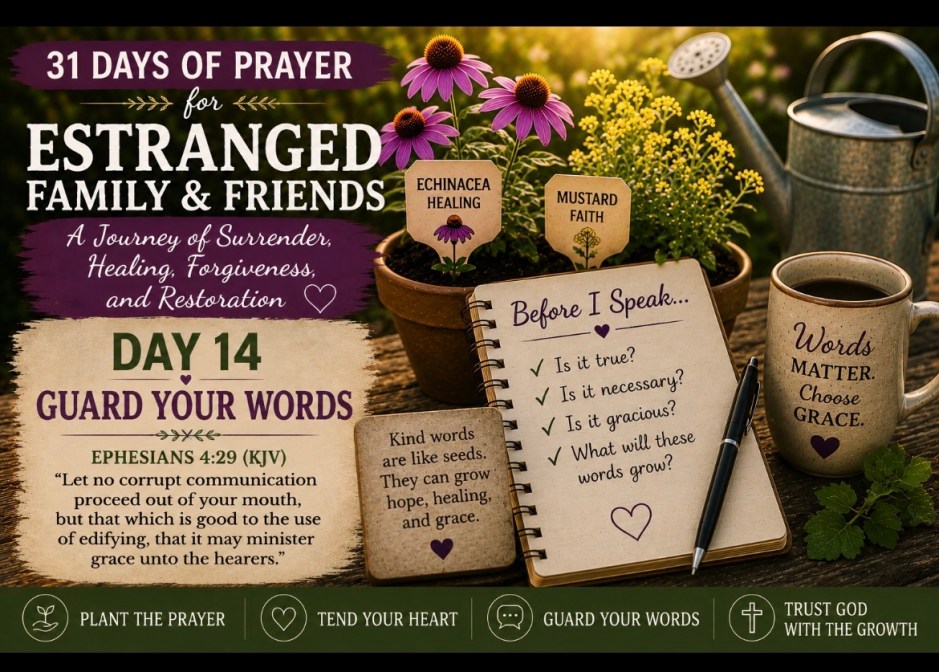
Scripture — Ephesians 4:29 KJV
“Let no corrupt communication proceed out of your mouth, but that which is good to the use of edifying, that it may minister grace unto the hearers.”
Welcome back to 31 Days of Prayer for Estranged Family and Friends—a journey of surrender, healing, forgiveness, and restoration.
Today we’ve reached Day 14 and the end of our second week together.
Yesterday, we talked about releasing the fearful “what ifs” that can fill our minds.
Today we’re going to pay attention to what happens next:
What comes out of our mouths.
Because words matter.
Words can encourage.
Words can comfort.
Words can clarify truth.
But words can also wound.
And in an already broken relationship, one sentence spoken from anger can deepen a wound that has taken years to heal.
Our Scripture today is Ephesians 4:29:
“Let no corrupt communication proceed out of your mouth, but that which is good to the use of edifying, that it may minister grace unto the hearers.”
Today our prayer is simple:
“Lord, guard my words, and let what I say minister grace.”
Words Are Seeds Too
Throughout this journey, we’ve talked a lot about seeds.
We’ve planted echinacea as a reminder of healing.
We’ve planted mustard as a reminder of faith.
But today I want us to consider another kind of seed.
Our words.
Every time we speak into a relationship, we’re planting something.
Some words plant peace.
Some plant hope.
Some plant understanding.
Others can plant suspicion, anger, shame, or resentment.
And once a word has been spoken, we can’t put it back into our mouths.
We may apologize for it.
God can heal the wound it caused.
But we cannot unsay it.
So before we scatter words into already tender soil, perhaps we need to ask:
“What will this grow?”
When Hurt Wants to Speak
Estrangement gives us plenty of opportunities to speak from pain.
Maybe someone says something about the person we’re estranged from.
Maybe we’re asked:
“What happened between you two?”
Maybe we receive a message that immediately makes our heart race.
And suddenly, we have a lot we want to say.
We want to defend ourselves.
Correct the record.
Explain their faults.
Prove our side.
And some situations genuinely require us to speak truth.
Guarding our words doesn’t mean remaining silent when something important needs to be said.
But Scripture gives us a standard for how we speak.
Paul says our words should be:
“…good to the use of edifying, that it may minister grace unto the hearers.”
So perhaps before speaking, we can pause and ask:
Is what I’m about to say true?
Is it necessary?
Is it being spoken from love—or from my wound?
And:
Will these words help build something, or am I simply trying to hurt because I’ve been hurt?
Guard What You Say About Them Too
And this doesn’t apply only when we’re speaking to the person.
It also applies when we’re speaking about them.
This can be especially challenging during estrangement.
We need people we can safely talk to.
There is nothing wrong with seeking wise counsel, prayer, or support.
But there’s a difference between seeking counsel and continually retelling someone’s failures.
Sometimes we can become so focused on making other people understand our side that we unintentionally recruit them into the conflict.
Our pain becomes gossip.
Our need for support becomes character assassination.
And one broken relationship begins affecting many others.
So today we might ask:
“Am I sharing this because I genuinely need wisdom—or because I want someone else to agree that I’m right?”
That’s a difficult question.
But it’s an important one.
Silence Can Be an Act of Faith
Sometimes guarding our words means speaking gently.
And sometimes it means not speaking yet.
You don’t have to answer every message immediately.
You don’t have to correct every misunderstanding the moment you hear it.
You don’t have to defend yourself in every conversation.
There may be times when the wisest response is:
“Lord, I’m too hurt to answer this well right now. Help me wait.”
That’s not weakness.
That’s self-control.
Sometimes the most gracious words are the ones we wait to speak until God has tended our hearts first.
Returning to Our Garden
Let’s come back to our echinacea and mustard.
The echinacea reminds us of healing.
If we’re praying for healing, we don’t want our words continually reopening the wound.
The mustard reminds us of faith.
And sometimes faith means trusting God enough that we don’t have to defend ourselves in every situation.
But today, let’s also think about the watering can.
When we water a garden, we’re careful about what we’re nourishing.
Our words can water things too.
Every time we rehearse bitterness, we water bitterness.
Every time we feed an argument, we water conflict.
But every time we speak truth with grace…
every time we encourage…
every time we pray instead of gossip…
we’re watering something different.
So ask yourself:
“What have my words been watering?”
Today’s Action — Pause Before You Speak
Today, write these four questions in your journal:
Before I speak…
Is it true?
Is it necessary?
Is it gracious?
What will these words grow?
And here’s today’s challenge:
If something triggers you—a text, a comment, a memory, or a conversation—don’t respond immediately.
Pause.
Pray.
If possible, wait until the emotion settles.
Then ask God:
“Father, what would You have me say?”
And if the answer is nothing…
let silence be enough.
Today’s Prayer
Let’s pray.
Heavenly Father,
Your Word says:
“Let no corrupt communication proceed out of your mouth, but that which is good to the use of edifying, that it may minister grace unto the hearers.”
Father, today I give You my words.
Guard my mouth when I’m angry.
Guard my words when I’m hurt.
Guard my tongue when I feel misunderstood.
Keep me from saying something simply because I want someone else to feel the pain I feel.
Forgive me for words I’ve spoken that wounded.
Forgive me for conversations where I shared more than I should have.
Forgive me if I’ve used other people’s failures to gain sympathy or agreement.
Teach me to seek wise counsel without gossip.
Teach me to speak truth without cruelty.
Teach me to establish boundaries without hatred.
Teach me to disagree without dishonoring.
And teach me when silence is wiser than another explanation.
Father, if the opportunity comes to speak with __________, prepare my words before that conversation ever happens.
Let my words be truthful.
Let them be humble.
Let them be gentle.
And let them minister grace.
If an apology is needed, help me give it.
If truth needs to be spoken, give me courage.
If a boundary needs to be communicated, give me wisdom.
And if nothing needs to be said, give me enough faith to remain quiet.
Father, guard the words I speak about __________ too.
Don’t let bitterness use my mouth to spread into other relationships.
Instead, when I’m tempted to speak against them, remind me to pray for them.
Today I ask You to put a guard over my mouth and tenderness in my heart.
May the words I plant today produce something that honors You.
In the name of Jesus Christ,
Amen.
And with that, we’ve reached the end of Week Two: Healing the Heart.
We’ve talked about forgiveness.
Confession.
Bitterness.
Spiritual warfare.
The armor of God.
Fearful thoughts.
And now…
our words.
The echinacea reminds us to pray for healing.
The mustard reminds us to walk by faith.
And today, the watering can reminds us to be careful about what we’re nourishing.
Because words are seeds too.
So before you speak today, ask:
“What will these words grow?”
If they’ll grow bitterness, perhaps don’t plant them.
If they’ll grow unnecessary conflict, perhaps leave them in the packet.
But when God gives you words of truth, grace, encouragement, repentance, or peace…
plant generously.
Plant the prayer. Tend your heart. Guard your words. Speak grace. And trust God with the growth.
And as always,
may your roots grow deep and your spirit stay nourished.
God bless you, and I’ll see you tomorrow.

