
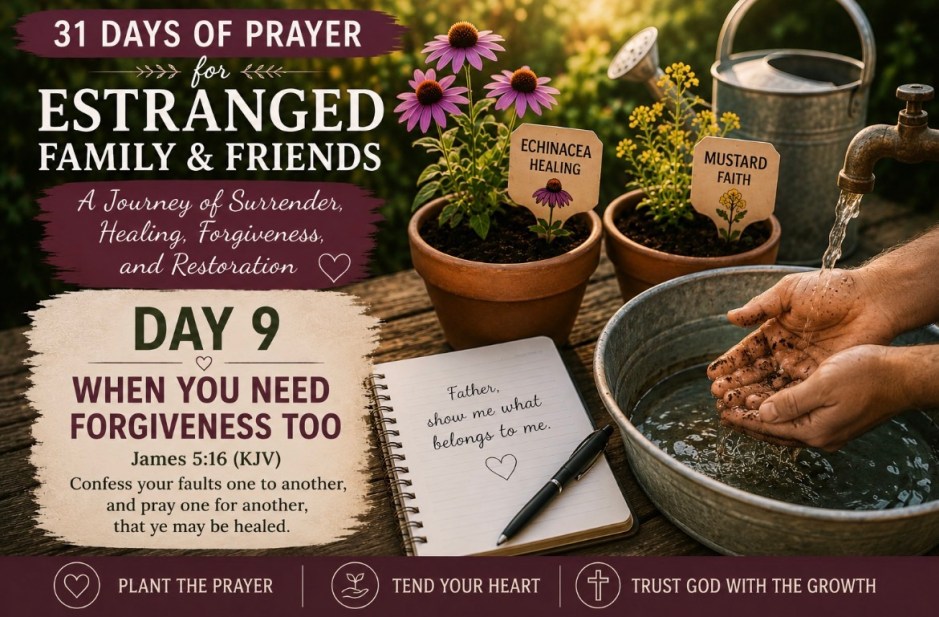
Scripture — James 5:16 KJV
“Confess your faults one to another, and pray one for another, that ye may be healed. The effectual fervent prayer of a righteous man availeth much.”
Welcome back to 31 Days of Prayer for Estranged Family and Friends—a journey of surrender, healing, forgiveness, and restoration.
Yesterday, we talked about choosing forgiveness.
We asked God to help us release the hurts we’ve been carrying and to keep bitterness from taking root in our hearts.
But today we’re going to turn that prayer around.
Because in a broken relationship, sometimes we have been deeply hurt.
And sometimes…
we have done some of the hurting too.
James 5:16 tells us:
“Confess your faults one to another, and pray one for another, that ye may be healed.”
Those words give us a beautiful connection:
confession, prayer, and healing.
So today we’re asking God for enough humility to recognize what belongs to us, enough courage to confess it, and enough faith to trust Him with what happens afterward.
What Part Belongs to Me?
When a relationship has become estranged, it can be very easy to see everything the other person did wrong.
We remember their words.
Their decisions.
The ways they disappointed us.
The ways they misunderstood us.
And perhaps some of those things really were wrong.
But yesterday, when we talked about forgiveness, we remembered the mercy God has extended to us.
Today we’re going one step further.
We’re asking:
“Father, is there something here for which I need forgiveness too?”
Maybe we responded harshly.
Maybe we were so busy defending ourselves that we didn’t listen.
Perhaps we allowed fear to become control.
Maybe we assumed motives we couldn’t actually know.
Perhaps we spoke about the person to others in ways we shouldn’t have.
Maybe we said something in anger that caused a wound.
Or perhaps God has already shown us something we’ve been reluctant to admit.
Today’s question isn’t:
“Was everything my fault?”
It is:
“What part of this belongs to me?”
Confession Isn’t Condemnation
There’s something important we need to understand about confession.
God isn’t inviting us to examine ourselves so He can shame us.
He’s inviting us into truth so He can heal us.
Listen again to the wording of James:
“Confess your faults one to another, and pray one for another, that ye may be healed.”
Healing is part of the picture.
When God exposes something in us, He isn’t doing it merely to point His finger at the wound.
He wants to tend it.
That’s very different from condemnation.
Condemnation says:
“Look what you’ve done. There’s no hope for you.”
Conviction says:
“This needs to change. Bring it to Me.”
And that’s what we’re doing today.
We’re bringing it to Him.
The Courage to Say “I Was Wrong”
Sometimes one of the most healing sentences in a relationship is also one of the hardest:
“I was wrong.”
Not:
“I’m sorry you felt that way.”
Not:
“I’m sorry, but you did this too.”
Not:
“I’m sorry if I offended you.”
Sometimes genuine repentance simply says:
“I was wrong when I did this. I’m sorry. Will you forgive me?”
That takes humility.
Because a sincere apology doesn’t require the other person to admit what they did before we’re willing to acknowledge what we did.
Their responsibility belongs to them.
Mine belongs to me.
And today I’m asking God to help me faithfully tend what belongs in my garden.
An Apology Isn’t a Bargaining Tool
There’s another difficult truth here.
If we apologize, we cannot control what the other person does with our apology.
They may forgive immediately.
They may need time.
They may say nothing.
They may not believe we’ve changed.
They may forgive us but still not be ready for reconciliation.
And that’s where everything we’ve practiced since Day One comes back:
surrender.
An apology cannot become:
“I said I was sorry, so now you have to come back.”
That’s not repentance.
That’s a transaction.
Instead we can say:
“God, I will do what is mine to do, and I will trust You with what happens next.”
Don’t Carry What Isn’t Yours
But there’s another side of this that I don’t want us to miss.
Taking responsibility doesn’t mean taking responsibility for everything.
When we desperately want a relationship restored, we can become tempted to accept blame that isn’t ours simply because we think doing so might bring someone back.
That’s not what we’re practicing.
Remember Day Three?
We prayed:
“Search me, O God.”
We’re asking God for truth.
That means we don’t want false innocence.
But we don’t want false guilt either.
If something belongs to us, we want enough humility to own it.
If something doesn’t belong to us, we can place it into God’s hands.
So our prayer becomes:
“Father, show me what is mine to carry—and what is mine to release.”
Repentance Produces New Growth
Sometimes saying “I’m sorry” is only the beginning.
If I apologize for not listening, then I need to learn to listen.
If I apologize for speaking harshly, then I need to learn gentleness.
If I apologize for trying to control someone, then I need to practice surrender.
If I apologize for crossing a boundary, then I need to learn to respect that boundary.
That’s repentance.
Repentance doesn’t only look backward and say:
“I wish I hadn’t done that.”
It looks forward and says:
“With God’s help, I want to walk differently.”
And perhaps that’s one of the greatest things God can accomplish during these 31 days.
We’re not merely asking Him to restore an old relationship exactly as it was.
We’re asking Him to change us so that, if reconciliation comes, we’re prepared to build something healthier.
Returning to Our Garden
And that brings us back to our echinacea and mustard.
The echinacea represents healing.
And today James reminds us that confession can be part of healing.
Sometimes we have to uncover what’s beneath the surface before it can be tended.
And the mustard represents faith.
Today mustard-seed faith might simply be enough faith to say:
“God, I don’t have to defend myself from You.”
He already knows.
We can bring Him the dirt.
The mistakes.
The regrets.
The places where we failed.
And His grace isn’t frightened by what He finds.
Think about washing soil from your hands after working in the garden.
You don’t stand at the basin ashamed that your hands became dirty.
You bring them to the water.
And perhaps that’s the picture we need today.
Bring it to God.
Let Him cleanse.
Let Him forgive.
Let Him teach you.
And then let Him help you return to the garden differently.
Today’s Action — What Belongs to Me?
Take out your journal today and write:
“Father, show me what belongs to me.”
Then sit quietly with God.
You might ask:
Did I speak words I need to apologize for?
Did I fail to listen?
Did I respond from anger?
Did fear cause me to become controlling?
Did I make assumptions about someone’s motives?
Did I cross a boundary?
Did I gossip or speak unkindly about them?
Is there something God has already shown me that I need to acknowledge?
Don’t manufacture guilt.
Let God lead the examination.
And if He brings something to mind, write it down.
Then pray:
“Father, forgive me and show me what repentance should look like here.”
You don’t necessarily have to send a message today.
Pray first.
Let God examine your motives.
And if He does lead you to apologize, keep it simple, specific, and without expectation:
“I’ve been praying about what happened, and I realize I was wrong when I ________. I’m truly sorry. I’m not asking anything from you. I simply wanted to take responsibility for what belongs to me.”
Then leave the outcome with God.
Today’s Prayer
Let’s pray.
Heavenly Father,
Your Word says,
“Confess your faults one to another, and pray one for another, that ye may be healed.”
So today, Father, I come before You with an open heart.
Show me what belongs to me.
Not what fear tells me belongs to me.
Not what someone else may unfairly place upon me.
And not what my pride tries to place entirely upon them.
Show me the truth.
If I have spoken words that wounded, forgive me.
If I failed to listen, forgive me.
If pride made me defensive, humble me.
If fear made me controlling, teach me to surrender.
If anger caused me to respond harshly, help me acknowledge it.
If I crossed boundaries, made assumptions, held grudges, or failed to love well, show me.
And give me the courage to say:
“I was wrong.”
Father, where an apology is appropriate, prepare my heart to give it sincerely.
Take away my excuses.
Keep me from using an apology as a way to manipulate someone into reconciliation.
Help me take responsibility simply because it is right before You.
And Father, protect me from false guilt.
Don’t let my desire for restoration cause me to take responsibility for something that isn’t mine.
Give me discernment.
Show me what I need to own. Show me what I need to release. And give me wisdom to know the difference.
If I ask forgiveness and the answer doesn’t come, help me wait.
If the person needs time, help me respect it.
If reconciliation doesn’t happen immediately, help me continue walking faithfully with You.
And Father…
don’t let my repentance end with words.
Change me.
Make me gentler.
Make me humbler.
Make me a better listener.
Make me slower to anger.
Make me quicker to repent.
And make me willing to love without trying to control the outcome.
I place __________ into Your hands again today.
I pray for their healing.
I pray for mine.
I pray for forgiveness where forgiveness is needed.
And if it is Your will for this relationship to be restored, prepare both of us to build something healthier than what existed before.
Thank You that when You reveal something in me that needs changing, You don’t leave me there.
You forgive.
You cleanse.
You teach.
And You grow something new.
Give me faith—even if it is only the size of a mustard seed—to trust Your grace with my failures.
In the name of Jesus Christ,
Amen.
Before we finish today, look again at our garden.
The echinacea reminds us that we’re praying for healing.
And today we’ve learned that sometimes healing begins with confession.
The mustard reminds us to have faith—even enough faith to admit where we’ve been wrong and trust God’s grace with what comes next.
And maybe today the water reminds us of something too.
We don’t have to hide the dirt on our hands.
We can bring it to God.
We can confess.
We can receive His grace.
And then we can allow Him to teach us how to return to the garden differently.
Yesterday we prayed:
“Lord, help me forgive.”
Today we’re praying:
“Lord, show me where I need forgiveness too.”
Tomorrow, for Day Ten: Uproot Bitterness, we’re going to look beneath the soil again and ask God to remove something that can quietly grow when wounds remain untended.
Until then…
Plant the prayer. Tend your heart. Own what is yours. Receive God’s grace. And trust Him with the growth.
And as always,
may your roots grow deep and your spirit stay nourished.
God bless you, and I’ll see you tomorrow.

