
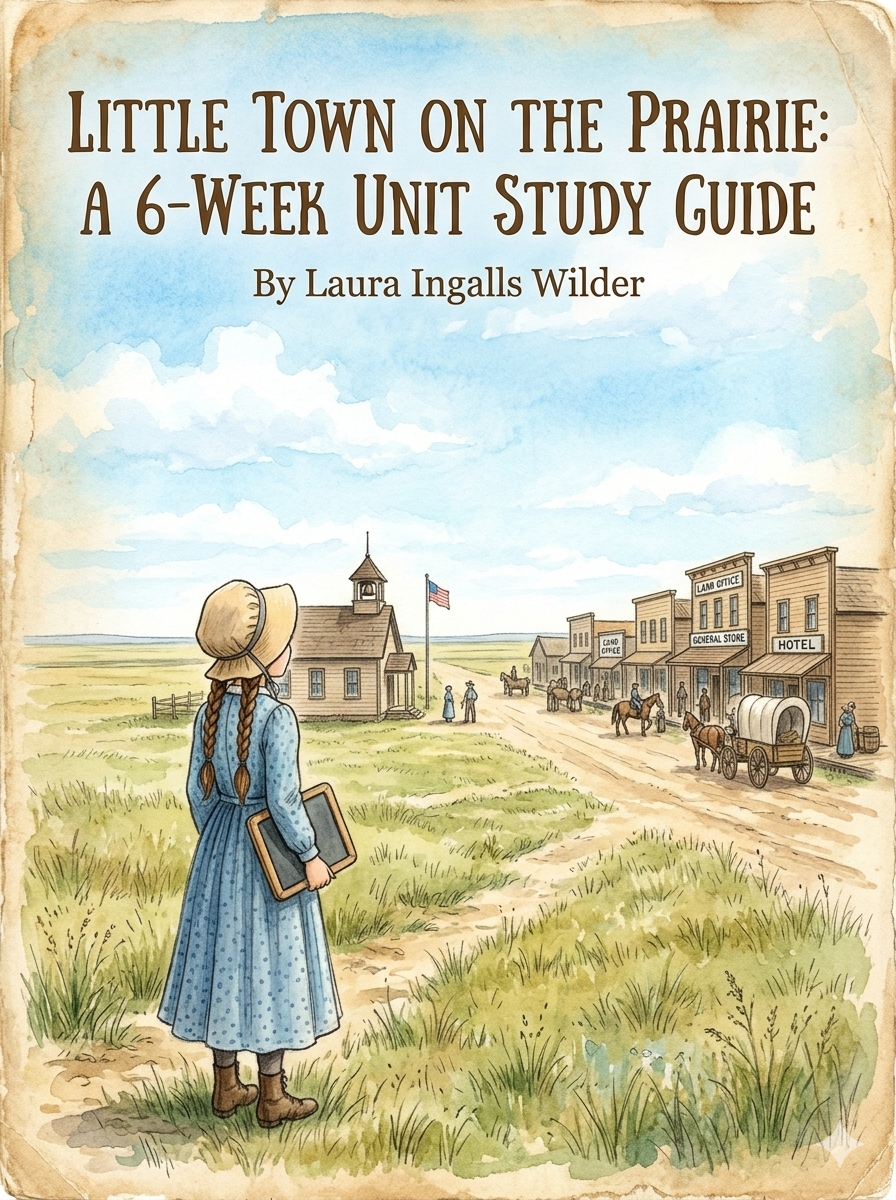
If your family fell in love with the high-stakes survival story of the Dakota blockades, then returning to the prairie as spring blooms is an absolute joy. In our homeschool, moving from the dark winter months into the bright, bustling pages of Little Town on the Prairie by Laura Ingalls Wilder** marked a beautiful transition—not just for the landscape, but for Laura herself. Seeing a fifteen-year-old Laura step up to take her first job sewing shirts in town sparked incredible family discussions about maturity, work ethic, and community duty. If you’re ready to channel that reading excitement into a complete, rigorous academic plan, here is our comprehensive 6-week unit study designed to turn this beloved classic into a hands-on learning adventure for your middle schooler.
**As an Amazon Associate, I earn from qualifying purchases. This post does contain some affiliate and/or referral links to products and/or services that we use. If you happen to click through a link and make a purchase, we may earn a teensy-weensy small commission (at NO EXTRA cost to you) if a purchase is made through these links. These links help to support our family, our blog, and our homeschooling mission. This means that we can keep bringing you great recipes, ideas, and tips for FREE! Click HERE for a full disclaimer. –Thank you!
Mornings:
We start every morning off with our prayers and the Pledge of Allegiance. Below is a video of how we start our mornings.
Don’t have a flag? Grab one HEREand print it out to put up somewhere… you could even let the kids make a flag to proudly display. Amazon also has some little ones like this one HERE and HERE.
Tip: If you want to go to a certain week/chapter or topic simply push the ‘ctrl’ and the ‘F’ button down together and a small bar will pop up. Type in the week number or chapter number you want and it will take you to it.
Little Town on The Prairie Unit Study Teacher Answer Key
Week 1: Prairie Spring & Homesteading (Chapters 1–4)
Reading Schedule:
- Day 1: Ch. 1 (Surprise)
- Day 2: Ch. 2 (Springtime on the Claim)
- Day 3: Ch. 3 (Happy Days)
- Day 4: Ch. 4 (The Double-Barreled Rifle)
Language Arts
Vocabulary:
- Shanty
- Gopher
- Immaculate
- Sod
- Dynamic
- provisions
Discussion Question:
- How does Laura’s attitude toward her work on the claim shanty reflect her growing mature responsibilities compared to the earlier books?
Writing Activity: Write an original descriptive paragraph detailing the transformation of an outdoor prairie field as winter turns into a vibrant spring.
Optional Activities:
Math Word Problem
Problem: Pa plants 2/5 of an acre of corn on his homestead claim on Monday, and 1/3 of an acre on Tuesday. If he needs to plant a total field size of 2 full acres of corn, how many fractions of an acre remain unplanted?
Optional Activities:
- Beginning Fractions & Decimals by Rock ‘N Learn
- Bubble Pop! Math Challenge Games – Gr. 3‑4
- CoolMath4Kids
- PBS Kids Games
Geography & History
Topic: The physical geography of Kingsbury County and De Smet. Look up historical records of early 1880 settlement tracts and how boundaries were staked using surveyor flags.
Optional Activities:
Science
Topic: Soil horizons and prairie ecosystems. Study the composition of deep prairie sod and examine how native grass root networks hold moisture and anchor topsoil against high winds.
Optional Activities:
- Mystery Science
- All About Life Science Activities
- National Geographic Match the Fact Cards
- National Geographic Kids What Animal Am I Card Game
Life Skills & Labs
Pioneer Records Lab (History Integration): Research the legal steps needed to prove up a “Tree Claim” vs. a regular Homestead Claim, noting why planting rows of trees was federally incentivized. See the end of this lesson plan.
Optional Activities:
Plain and Not So Plain Home Economics Course (she has other subjects as well)
PE, Health & Safety
Topic: Firearm handling protocols. Analyze Pa’s strict protocols when cleaning and handling his double-barreled rifle to teach basic gun safety concepts.
Art, Music & Crafts
Topic: Sketching wildlife. Practice a graphite pencil drawing of a native prairie gopher or a wild bird mentioned in the early spring chapters.
Week 1: Pioneer Records Lab
Student Activity Pages & Guided Historical Research
Unit Context: Chapter 1 (Surprise) & Chapter 2 (Springtime on the Claim)
Student Name: ____________________
Date Started: ____________ Date Completed: ____________
Part 1: Background & Reading Connection
In the opening chapters of Little Town on the Prairie, the Ingalls family returns to their homestead claim for the spring. Pa works hard to build up their small claim shanty, plow the soil, and plant crops. This land was not purchased from a typical real estate agent; it was claimed under the Homestead Act of 1862, a federal law designed to encourage settlement of the western territories.
To earn absolute ownership (the deed) of a 160-acre plot, a pioneer had to pay a small filing fee, build a permanent home, live on the land for five continuous years, and successfully cultivate crops.
Today, you will step into the shoes of a historian. You will use a live federal database to unearth the original land patent records for the Ingalls family in Kingsbury County, Dakota Territory.
Part 2: Research Setup & Database Navigation
To find your primary source documents, follow these exact navigation steps on a computer or tablet:
Open your web browser and go to the official Bureau of Land Management General Land Office (GLO) Records Database.
Click on the “Search Land Patents” tab or link on the main menu.
In the search fields, filter your parameters precisely:
State: Select South Dakota from the dropdown menu.
Last Name: Type Ingalls into the box.
First Name: Type Charles into the box.
Click the “Search” button at the bottom of the form.
Part 3: Primary Source Data Extraction
Locate the record matching Charles P. Ingalls in Kingsbury County and click on the “Patent Image” or “Doc ID” link to extract the historical data.
The Legal Document Identity: What is the official Land Patent Document Number issued to Charles P. Ingalls?
The Timeline of Ownership:
What is the exact Issue Date stamped on this final land patent?
Land Authority:
Which United States President’s name is signed at the bottom of this official land deed? (Note: This may be signed by an official secretary on behalf of the President).
Geographical Land Description: Copy down the exact Township, Range, and Section numbers listed under the legal land description. This grid allowed the government to pinpoint his exact plot on an empty prairie map.
Section Number: ____________
Township Number: ____________
Range Number: ____________
Part 4: Critical Thinking & Historical Analysis
Answer the following questions based on your readings and your database discoveries.
The Filing Timeline Gap: Look closely at the Issue Date on Pa’s land patent. The Ingalls family moved to this claim in late 1879/early 1880, but the deed wasn’t finalized until years later. Based on the rules of the Homestead Act, explain why there is such a massive multi-year gap between the day a family pitched their tent and the day they officially received their land patent.
The “Tree Claim” Alternative: In addition to this homestead, Pa files for a neighboring Timber Culture Claim (often called a tree claim). Under this specific law, a pioneer didn’t have to build a house, but they had to successfully grow 10 acres of trees on the treeless prairie. Why would the United States government want to give away free land just to convince pioneers to plant dense rows of trees? Think about weather, wind, and resources.


One thought on “Little Town on The Prairie Unit Study Week 1”