
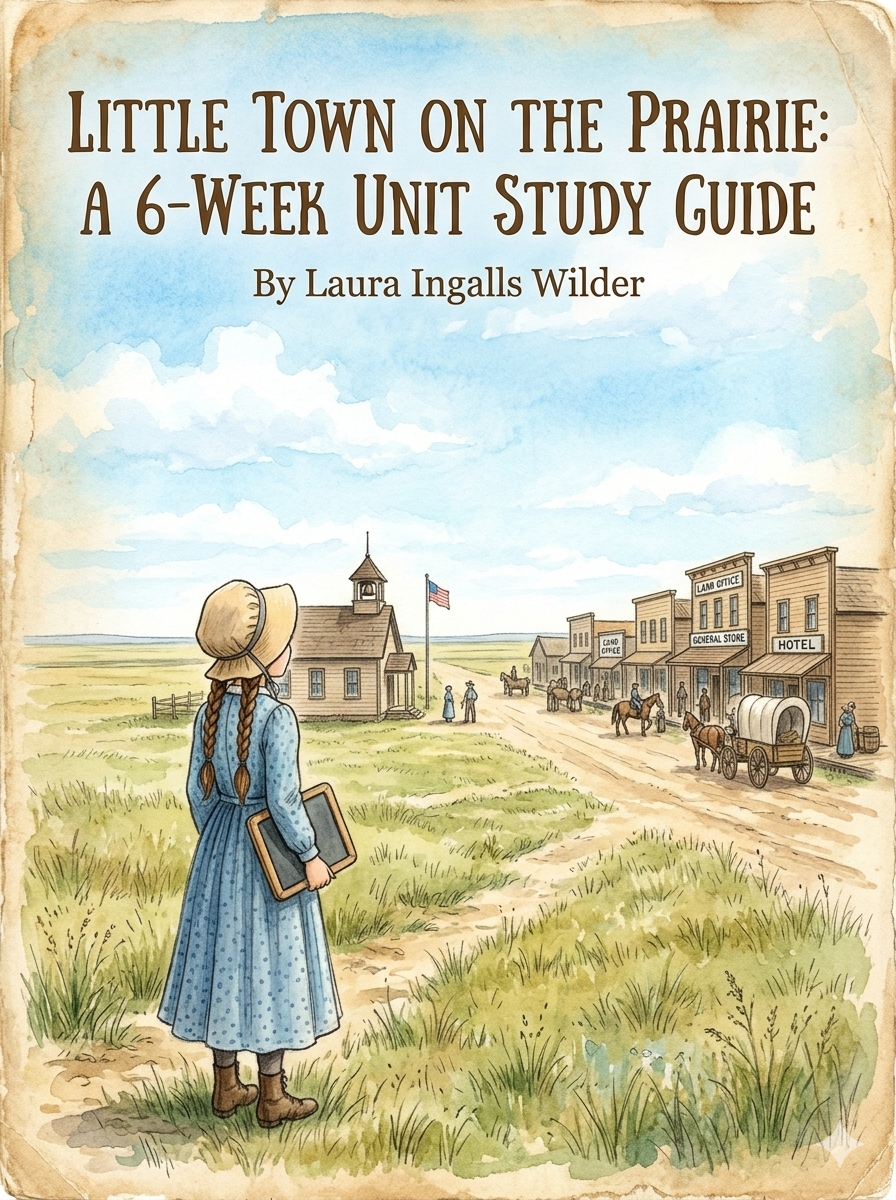
If your family fell in love with the high-stakes survival story of the Dakota blockades, then returning to the prairie as spring blooms is an absolute joy. In our homeschool, moving from the dark winter months into the bright, bustling pages of Little Town on the Prairie by Laura Ingalls Wilder** marked a beautiful transition—not just for the landscape, but for Laura herself. Seeing a fifteen-year-old Laura step up to take her first job sewing shirts in town sparked incredible family discussions about maturity, work ethic, and community duty. If you’re ready to channel that reading excitement into a complete, rigorous academic plan, here is our comprehensive 6-week unit study designed to turn this beloved classic into a hands-on learning adventure for your middle schooler.
**As an Amazon Associate, I earn from qualifying purchases. This post does contain some affiliate and/or referral links to products and/or services that we use. If you happen to click through a link and make a purchase, we may earn a teensy-weensy small commission (at NO EXTRA cost to you) if a purchase is made through these links. These links help to support our family, our blog, and our homeschooling mission. This means that we can keep bringing you great recipes, ideas, and tips for FREE! Click HERE for a full disclaimer. –Thank you!
Mornings:
We start every morning off with our prayers and the Pledge of Allegiance. Below is a video of how we start our mornings.
Don’t have a flag? Grab one HEREand print it out to put up somewhere… you could even let the kids make a flag to proudly display. Amazon also has some little ones like this one HERE and HERE.
Tip: If you want to go to a certain week/chapter or topic simply push the ‘ctrl’ and the ‘F’ button down together and a small bar will pop up. Type in the week number or chapter number you want and it will take you to it.
Little Town on The Prairie Unit Study Teacher Answer Key
Week 4: The Winter Socials (Chapters 14–17)
Reading Schedule:
- Day 1: Ch. 14 (Sent Sentenced)
- Day 2: Ch. 15 (The Evening Company)
- Day 3: Ch. 16 (The Lyceum)
- Day 4: Ch. 17 (The Sociable)
Language Arts
Vocabulary:
- Foraging
- Eluded
- Eloquent
- Recitation
- Standard
- hospitable
Discussion Question:
- Why were community institutions like the Lyceum and literary debates so essential to the mental health and survival of isolated prairie families during dark winters?
Writing Activity: Write an argumentative opening statement for a formal debate on whether modern technology has made people more or less connected as a community.
Optional Activities:
Math Word Problem: Linear Equations & Civic Cost Auditing
Problem: The town’s local Lyceum hall has a flat rental fee of $5.00 per night, plus an operational heating oil charge of $0.35 per hour of use. Write a linear cost equation and find the total price to run a community social that lasts exactly 4 hours. (See the instructions at the end of the lesson plan.)
Optional Activities:
- Beginning Fractions & Decimals by Rock ‘N Learn
- Bubble Pop! Math Challenge Games – Gr. 3‑4
- CoolMath4Kids
- PBS Kids Games
Geography & History
Topic: The history of the Lyceum Movement in America. Learn how public debates, guest lectures, and shared reading circles promoted adult civic literacy and frontier fellowship.
Optional Activities:
Science
Topic: Acoustic energy and vocal projection. Research how sound waves bounce off flat wooden walls inside crowded, unamplified historical assembly halls to make speech clear to large crowds.
Optional Activities:
- Mystery Science
- All About Life Science Activities
- National Geographic Match the Fact Cards
- National Geographic Kids What Animal Am I Card Game
Life Skills & Labs
The Hospitality Kitchen Lab (Life Skills Integration): Bake a traditional batch of simple molasses cookies or basic pioneer popcorn balls to practice hosting a formal “Evening Company” social hour.
Optional Activities:
Plain and Not So Plain Home Economics Course (she has other subjects as well)
PE, Health & Safety
Topic: Air purity around crowded coal stoves. Discuss the safety issues of heating enclosed, poorly ventilated structural halls full of large crowds using primitive fuel.
Art, Music & Crafts
Topic: Literary performance. Choose a classic historical poem (like Tennyson’s works) and practice the dramatic art of pioneer elocution and recitation, focusing on proper breath control.
Week 4: The Lyceum Sociable Ledger Card
Linear Equations & Civic Cost Auditing
Unit Context: Chapter 16 (The Lyceum) & Chapter 17 (The Sociable)
Student Name: ____________________
Date Started: ____________ Date Completed: ____________
Part 1: Background & Reading Connection
In Chapters 16 and 17, the townspeople of De Smet realize they need a way to keep their spirits high during the long prairie winter. They establish a local Lyceum, hosting community events filled with spelling bees, dramatic recitations, and formal debates on Calumet Avenue.
To host these socials inside a drafty public hall, the town committee has to manage structural expenses. Fuel for the coal stove and lighting oil for the wall lamps cost money, meaning they must track a strict budget to ensure the social circle doesn’t run into debt.
Today, you will act as the financial secretary for the De Smet Lyceum Committee. You will use a traditional business ledger card to calculate operational expenses using linear equations, track incoming entry fees, and balance the community book.
Part 2: Structural Expense Parameters
The building committee has negotiated the following cost parameters for renting the town hall:
Base Facility Rental Fee (Fixed Cost): $5.00 flat fee per evening to unlock and clean the hall.
Operational Heating Oil Surcharge (Variable Cost): $0.35 per hour of continuous furnace use to combat the sub-zero outdoor temperatures.
Write a linear equation expressing the total cost (C) to run an event as a function of operational hours (h):
Equation: C = ________________________
Calculate the exact total cost to host a Saturday night Lyceum debate that lasts for 4 hours:
Show your work: _____________________________________________________
Total Cost Value: ____________
Part 3: The De Smet Lyceum Balance Ledger
Instructions: As the town secretary, log each financial transaction chronologically onto the ledger card matrix below. Calculate the running balance after every single line item entry. (Hint: Expenses drop your balance down, while entry revenues push your balance up).
Starting Cash Reserve Balance: $10.00
Entry ID Transaction Description Category Cash Out (-) Cash In (+) Running Balance
00 Baseline Cash Opening Balance Reserve — — $10.00
01 Paid Flat Facility Hall Rental Fee Expense $5.00 — __________
02 Paid for 4 Hours of Heating Oil Surcharge Expense __________ — __________
03 Collected Admission Fees from 40 Town Adults Revenue — $4.00 __________
04 Collected Admission Fees from 18 Children Revenue — $0.90 __________
05 Purchased Popcorn kernels for the Sociable Expense $0.65 — __________
Part 4: Financial Secretary Review Analysis
Answer the following summary evaluation questions using your balanced ledger sheet entries.
Net Position Analysis: At the conclusion of the evening, what is the final cash balance remaining on your ledger sheet card? Did the Lyceum turn a net profit or suffer a loss for the night?
________________________________________________________________________
Per-Capita Value Metrics: The total admission fee collected from the 40 adults who attended was $4.00 total. Calculate the individual unit admission price per adult in cents.
________________________________________________________________________
Homestead Social Evaluation: Why would a frontier community willing pay their hard-earned cash coins to attend a spelling bee or a debate when money was so tight during a winter shortage?
________________________________________________________________________


One thought on “Little Town on The Prairie Unit Study Week 4”