
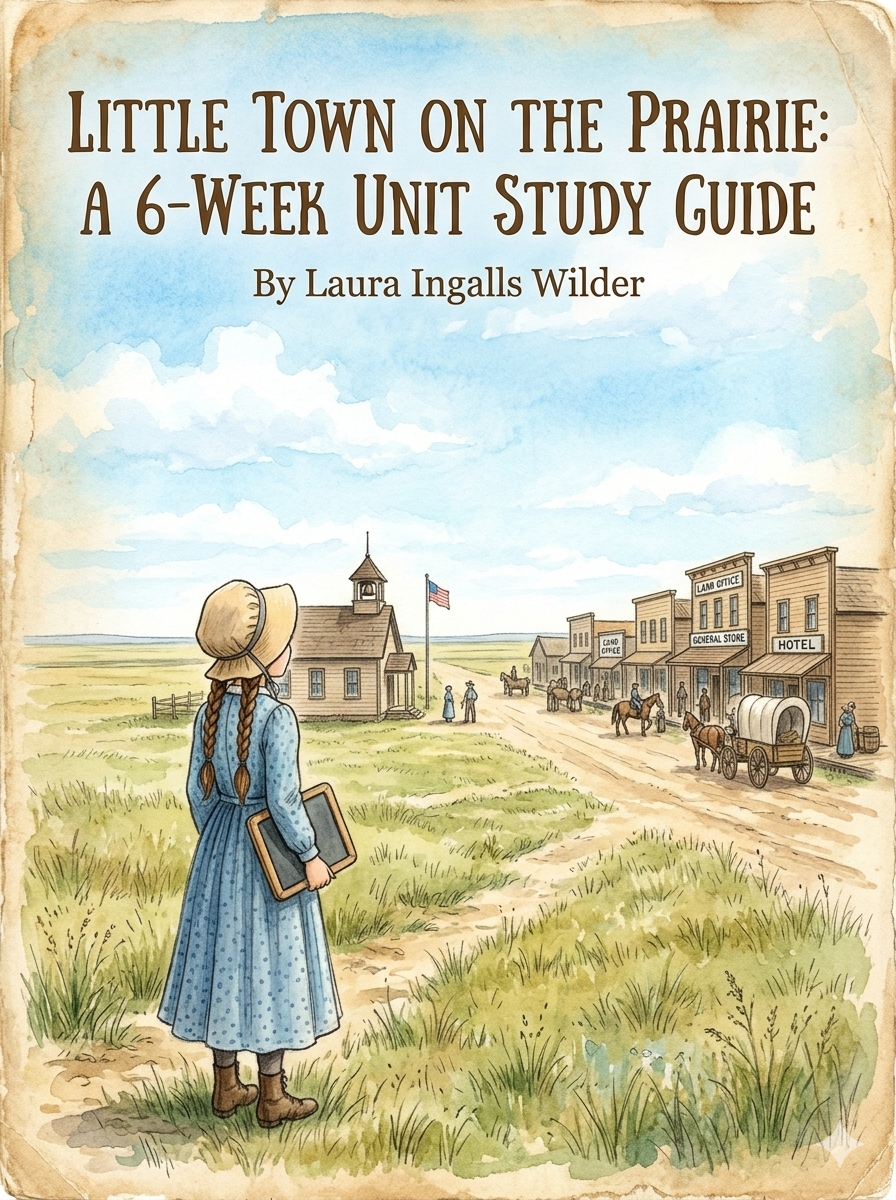
If your family fell in love with the high-stakes survival story of the Dakota blockades, then returning to the prairie as spring blooms is an absolute joy. In our homeschool, moving from the dark winter months into the bright, bustling pages of Little Town on the Prairie by Laura Ingalls Wilder** marked a beautiful transition—not just for the landscape, but for Laura herself. Seeing a fifteen-year-old Laura step up to take her first job sewing shirts in town sparked incredible family discussions about maturity, work ethic, and community duty. If you’re ready to channel that reading excitement into a complete, rigorous academic plan, here is our comprehensive 6-week unit study designed to turn this beloved classic into a hands-on learning adventure for your middle schooler.
**As an Amazon Associate, I earn from qualifying purchases. This post does contain some affiliate and/or referral links to products and/or services that we use. If you happen to click through a link and make a purchase, we may earn a teensy-weensy small commission (at NO EXTRA cost to you) if a purchase is made through these links. These links help to support our family, our blog, and our homeschooling mission. This means that we can keep bringing you great recipes, ideas, and tips for FREE! Click HERE for a full disclaimer. –Thank you!
Mornings:
We start every morning off with our prayers and the Pledge of Allegiance. Below is a video of how we start our mornings.
Don’t have a flag? Grab one HEREand print it out to put up somewhere… you could even let the kids make a flag to proudly display. Amazon also has some little ones like this one HERE and HERE.
Tip: If you want to go to a certain week/chapter or topic simply push the ‘ctrl’ and the ‘F’ button down together and a small bar will pop up. Type in the week number or chapter number you want and it will take you to it.
Little Town on The Prairie Unit Study Teacher Answer Key
Week 5: Transitions & Ambitions (Chapters 18–21)
Reading Schedule:
- Day 1: Ch. 18 (Literary)
- Day 2: Ch. 19 (The Whirl of Popularity)
- Day 3: Ch. 20 (The Birthday Party)
- Day 4: Ch. 21 (The Dark Winter)
Language Arts
Vocabulary:
- Perilous
- Hoarded
- Etiquette
- Meticulous
- Milestone
- transition
Discussion Question:
- How do the birthday gift expectations and formal etiquette rules during Laura’s teenage years contrast with the simpler gifts she received as a young child?
Writing Activity: Write a formal, third-person invitation to an 1880-style birthday party, detailing precise dress expectations and behavior rules.
Optional Activities:
Math Word Problem
Problem: Ma plans to bake a specialized layer cake that demands 3.5 cups of refined flour. If her storage tin holds a total volume capacity of 14 cups of flour, how many full cake batches can she bake before emptying the tin?
Optional Activities:
- Beginning Fractions & Decimals by Rock ‘N Learn
- Bubble Pop! Math Challenge Games – Gr. 3‑4
- CoolMath4Kids
- PBS Kids Games
Geography & History
Topic: Social structures, etiquette guides, and behavioral rules of Victorian-era youth on the American frontier. Study how fashion variations adjusted as teenagers transitioned toward adulthood.
Optional Activities:
Science
Topic: Thermodynamics of baking chemical leaveners. Research the chemical reactions of baking powders and cream of tartar inside an oven when creating soft cake crumb textures.
Optional Activities:
- Mystery Science
- All About Life Science Activities
- National Geographic Match the Fact Cards
- National Geographic Kids What Animal Am I Card Game
Life Skills & Labs
The Etiquette Lab (Life Skills Integration): Practice setting an authentic formal historical table setting, demonstrating correct layout patterns for knives, forks, spoons, plates, and cups. (See instructions at the end of the lesson.)
Optional Activities:
- Plain and Not So Plain Home Economics Course (she has other subjects as well)
PE, Health & Safety
Topic: Mental health wellness through community interaction. Study how group games and social interaction served as a psychological shield against cabin fever and winter depression.
Art, Music & Crafts
Topic: Intricate embroidery. Trace a simple monogram pattern onto a clean cotton handkerchief and use basic embroidery floss to stitch your initials, mirroring historical adolescent skills.
Week 5: The Victorian Etiquette & Formal Dinners Guide
Social Custom Analysis & Historical Table Mapping
Unit Context: Chapter 20 (The Birthday Party) & Chapter 21 (The Dark Winter)
Student Name: ____________________
Date Started: ____________ Date Completed: ____________
Part 1: Background & Reading Connection
In Chapter 20, Laura celebrates her sixteenth birthday and attends a gathering that highlights her growth into a young adult. As teenagers transitioned into Victorian society during the late 19th century, they had to navigate a complex system of social etiquette.
These unwritten laws dictated exactly how a person stood, spoke, dressed, and even how they held their fork at a formal dinner table. For frontier families, maintaining strict social manners was a way to keep cultural traditions alive, proving that a small prairie town could be just as refined and civilized as any bustling eastern city.
Today, you will step back into 1881 to examine these traditional manners, map out a historically accurate dinner setting, and explore how social expectations changed as Laura grew up.
Part 2: The Formal Place Setting Grid
Instructions: When hosting a formal dinner company, a Victorian table setting had to follow absolute mathematical symmetry. Draw a structural bird’s-eye view diagram of a formal place setting inside a box based on the historical rules listed. Label each object clearly.
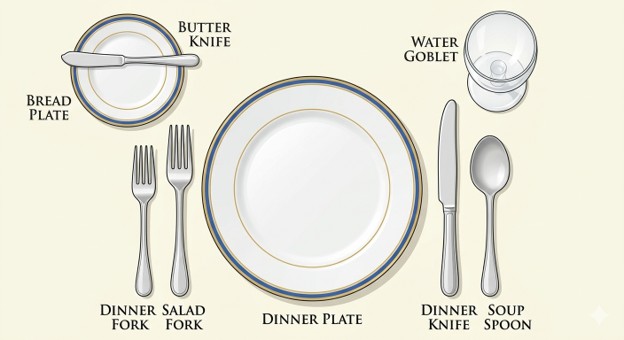
Mapping Rules to Follow:
The Center: Draw a large circle directly in the middle of your space to represent the main Dinner Plate.
The Left Side: Draw two parallel vertical lines on the left side of the plate. Label the inner line “Dinner Fork” and the outer line “Salad Fork”.
The Right Side: Draw two parallel vertical lines on the right side of the plate. Label the inner line “Dinner Knife” (ensure the sharp blade edge faces toward the plate). Label the outer line “Soup Spoon”.
The Upper Grid: Draw a small circle directly above the top right corner of the plate. Label this the “Water Goblet”. Place a small horizontal line just to its left, labeled “Bread Knife & Butter Plate”.
Part 3: The 1881 Social Etiquette Quiz
Instructions: Read these actual rule statements excerpted from 19th-century behavior manuals. Circle whether the statement is TRUE or FALSE based on Victorian expectations, then explain your reasoning.
Rule: When sitting at a formal dinner table, it is polite to lean back completely, cross your legs comfortably, and rest your elbows heavily on the wooden tabletop.
Circle One: TRUE / FALSE
Why? ________________________________________________________________________
Rule: If a formal birthday party invitation is written in the third person (e.g., “Miss Wilder requests the pleasure of your company”), your written reply must match that exact same formal, third-person style.
Circle One: TRUE / FALSE
Why? ________________________________________________________________________
Part 4: Analytical Essay Response
Answer the question below in a complete, multi-sentence paragraph, citing evidence from the text.
Prompt: Think back to the early books in the series (like Little House in the Big Woods), where Laura’s favorite gifts were a simple homemade rag doll named Charlotte and a single stick of peppermint candy. Contrast those childhood memories with the expectations and gifts featured during her sixteenth birthday party in Little Town on the Prairie. What do these shifting expectations tell us about her changing role within the Ingalls family and frontier society?
________________________________________________________________________________
The Etiquette Practicum: Hands-on Lab
To complete the Life Skills portion of this week’s study, have the student practice setting your home dinner table following the exact layout mapped out in Part 2. Run a formal meal where family members practice sitting up straight, keeping elbows off the table, and passing food items politely using 1881 conversational courtesies.


One thought on “Little Town on The Prairie Unit Study Week 5”