
Scripture — Proverbs 15:1 KJV
“A soft answer turneth away wrath: but grievous words stir up anger.”
Welcome back to 31 Days of Prayer for Estranged Family and Friends—a journey of surrender, healing, forgiveness, and restoration.
On Day One, we placed the person we love into God’s hands.
On Day Two, we learned to trust God with what we cannot see.
On Day Three, we prayed perhaps one of the most difficult prayers of this journey:
“Search me, O God.”
We invited God to examine the soil of our own hearts.
And today, we’re going to continue that heart work by looking at something that can quietly keep broken relationships broken:
our need to be right.
Our Scripture for today is Proverbs 15:1:
“A soft answer turneth away wrath: but grievous words stir up anger.”
Today we’re going to ask God to help us lay down the argument, soften our words, and choose humility over the need to prove our point.
When Being Right Becomes More Important Than the Relationship
Have you ever had an argument long after the actual argument was over?
I know I have.
The conversation ends, but we continue it in our minds.
We remember what they said.
Then we think of what we should have said.
We construct the perfect response.
We explain our side again.
We imagine what we would say if they would just give us another opportunity.
And somewhere along the way, we can become more concerned with being understood than with understanding.
More concerned with being vindicated than with healing.
More concerned with proving who was right than asking what would bring peace.
That doesn’t mean truth doesn’t matter.
It absolutely does.
And humility doesn’t require us to agree with something that isn’t true.
But there is a difference between standing for truth and needing to win.
Sometimes the question isn’t:
“Am I right?”
Sometimes the better question is:
“What kind of heart am I bringing into this conversation?”
A Soft Answer
Proverbs gives us such a simple
Notice that Scripture doesn’t say a soft answer guarantees the other person will respond softly.
We cannot control their response.
We can only choose ours.
And that distinction matters tremendously in estranged relationships.
You may not be able to change what another person says.
You cannot control what they believe about the past.
You cannot make them interpret your intentions correctly.
But you can ask God:
“How do You want me to respond?”
A soft answer isn’t necessarily a weak answer.
It can still contain truth.
It can still establish a boundary.
It can still say:
“That hurt me.”
It can still say:
“I cannot agree with that.”
It can still say:
“I need some time.”
Softness doesn’t mean abandoning truth.
It means refusing to use truth as a weapon.
The Words We Wish We Could Take Back
Many broken relationships carry the weight of words.
Words spoken in anger.
Words written in a text message.
Words sent before we had time to pray.
Words we thought would finally make someone understand how much they hurt us.
And perhaps words we wish we could take back.
Proverbs warns us:
“Grievous words stir up anger.”
Sometimes the words themselves become another wound.
Then the response creates another wound.
And before long, nobody even remembers where the original injury ended and the new ones began.
That’s why one of the greatest acts of surrender during conflict can simply be:
pausing.
Not every thought needs to be spoken.
Not every accusation needs an answer.
Not every misunderstanding has to be corrected immediately.
And not every argument needs to be won.
Sometimes wisdom looks like silence long enough for anger to settle.
Releasing the Need to Have the Last Word
This can be especially difficult when someone has misunderstood you.
We naturally want to explain.
We want them to know what really happened.
We want to correct the story.
And sometimes an explanation is appropriate.
But there may also come a point when we have explained all we can.
Continuing to argue won’t create understanding.
It will only deepen the divide.
At that point, faith may look like saying:
“God, You know the truth. I don’t have to make everyone understand me.”
That’s surrender too.
Maybe today we need to release the need to have the last word.
What This Does NOT Mean
I want to pause here because this is important.
Choosing a soft answer doesn’t mean tolerating cruelty or remaining in harmful situations.
Releasing the need to be right doesn’t mean accepting blame for things you didn’t do.
Forgiveness doesn’t require pretending something wasn’t painful.
And reconciliation doesn’t mean abandoning healthy boundaries.
We’re not learning to silence ourselves.
We’re learning to surrender our pride, anger, and need for control so that when we do speak, our words come from wisdom rather than woundedness.
There is a big difference.
Returning to Our Seeds
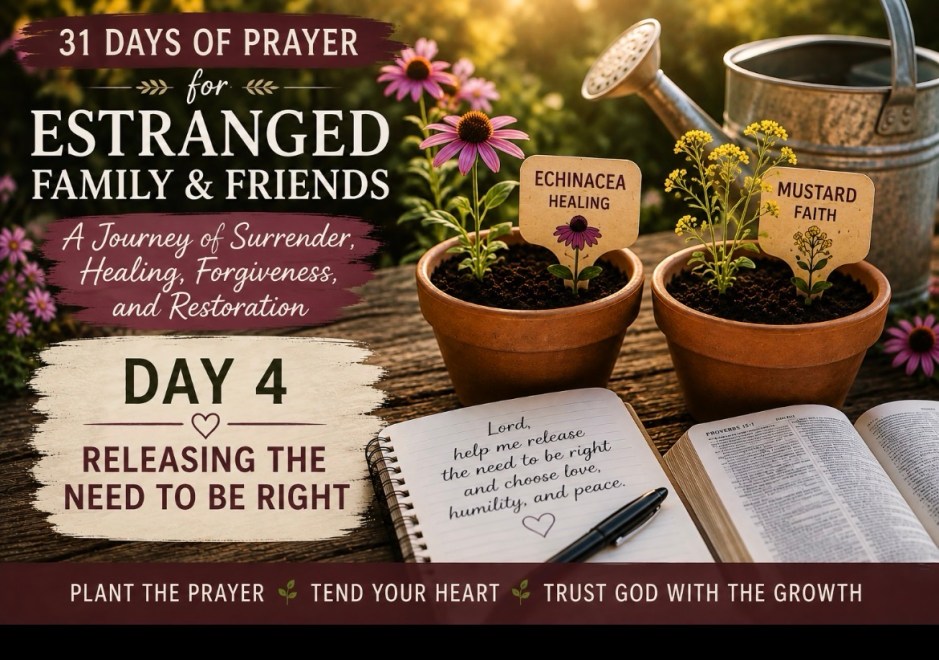
Let’s come back to the echinacea and mustard we’ve been tending throughout this journey.
The echinacea represents healing.
And sometimes healing requires us to stop reopening the wound with the same argument.
The mustard represents faith.
And today faith may mean trusting God with our reputation, our side of the story, and our desire to be understood.
We don’t have to force another person’s heart to see things exactly as we do.
We can speak truth with gentleness and then place the outcome into God’s hands.
And there’s another garden lesson here.
If I continually disturb the soil around a young plant, pulling it up and repositioning it because I’m worried about how it’s growing, eventually I can damage the very roots I’m trying to nurture.
Some things need to be left alone long enough to heal.
Perhaps some conversations do too.
Today’s Action — Lay Down the Argument
Today I want you to think about the argument you continue having in your mind.
Maybe you know exactly which one it is.
What do you desperately want the other person to understand?
What do you wish you could prove?
What response have you rehearsed?
Write it down if that helps.
Then underneath it write:
“Lord, I release my need to win this argument.”
And before you send a text, email, or message today—especially one written from hurt—pause.
Ask yourself:
Is it true?
Is it necessary?
Can I say it gently?
And perhaps most importantly:
Am I trying to bring peace—or am I trying to win?
Then give yourself permission to wait before responding.
Today’s Prayer
Let’s pray.
Heavenly Father,
Your Word says,
“A soft answer turneth away wrath: but grievous words stir up anger.”
Today I ask You to make my words soft without making me afraid of truth.
Give me wisdom to know when to speak and when to remain silent.
Forgive me for the times my words have added hurt to an already painful situation.
Forgive the words I have spoken in anger.
Forgive the messages I sent because I wanted someone else to hurt as much as I was hurting.
Forgive me for the arguments I continue rehearsing in my mind.
And Father, where I have been wounded by someone else’s words, heal those wounds too.
Help me release the need to defend myself constantly.
Release me from the need to have the last word.
Release me from the need to make another person admit that I was right.
Where pride has taken root, uproot it.
Where anger has taken root, replace it with peace.
Where resentment has taken root, begin growing forgiveness.
Father, if You open a door for reconciliation with __________, prepare my words before that conversation ever happens.
Help me listen.
Help me remain calm.
Help me acknowledge where I was wrong.
Help me speak truth with love.
And when I am misunderstood, remind me that You know my heart.
I don’t have to control another person’s opinion of me.
Today I place __________ into Your hands again.
I place the argument into Your hands.
I place my reputation into Your hands.
I place my need to be understood into Your hands.
And I place my need to be right into Your hands.
Teach me to value peace more than victory.
And let the words of my mouth reflect the work You are doing in my heart.
In the name of Jesus Christ,
Amen.
Closing
Before we finish today, remember what our plants are teaching us.
The echinacea reminds us to pray for healing.
The mustard reminds us to have faith—even if our faith is only the size of a mustard seed.
And today, the soil reminds us that we don’t have to keep disturbing something in order for God to work beneath the surface.
Some things need time.
Some conversations need space.
Some wounds need healing.
And some arguments simply need to be laid down.
So today:
Plant the prayer.
Tend your heart.
Choose the soft answer.
Release the need to win.
And trust God with the growth.
Tomorrow we’ll continue with Day Five: Giving God the Past.
Until then,
may your roots grow deep
and your spirit stay nourished.
God bless you, and I’ll see you tomorrow.

