
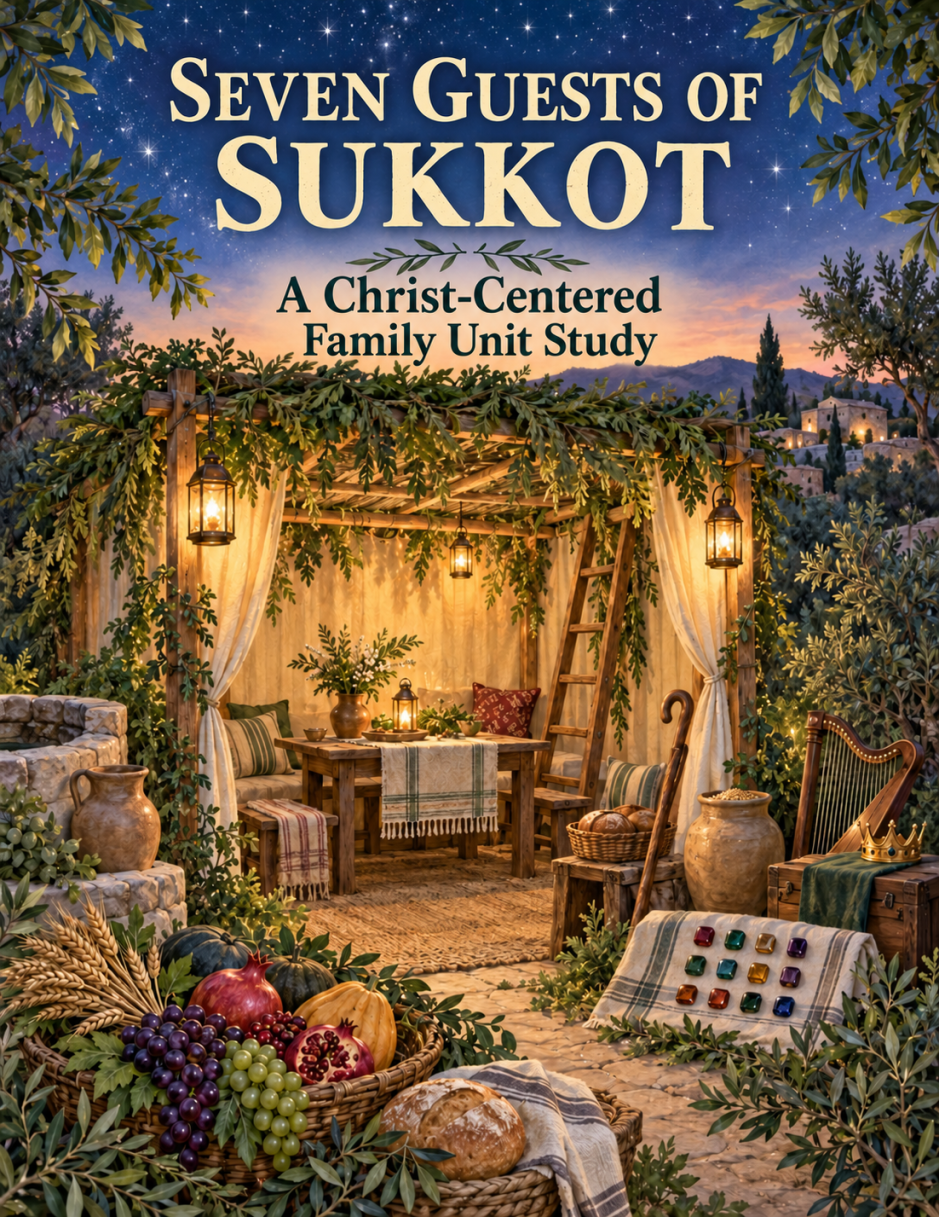
I have put together a unit study for my kiddos for the week of Sukkot. We may not get to all of these, but we can definitely try and hopefully it will give us all a better understanding of the Bible and some of the lost traditions and feasts that we need to bring back. We need to keep in mind that these are appointed days of the LORD and not just Jewish holidays… as Christians it is important to remember these days and keep them in a way that honors GOD.
Keeping Christ at the Center
Our family does not observe Sukkot as a means of earning salvation or proving ourselves more righteous than other believers. We study it because the appointed times help us understand the biblical story more fully.
Sukkot reminds us that earthly homes and possessions are temporary. God sustained Israel in the wilderness, dwelt among His people in the tabernacle, and came to dwell among us in Jesus Christ.
“And the Word was made flesh, and dwelt among us.”
— John 1:14 KJV
The feast also directs our attention toward the day when temporary dwelling will give way to something permanent:
“Behold, the tabernacle of God is with men, and he will dwell with them.”
— Revelation 21:3 KJV
That is the hope I want our children to carry away from this study. Abraham, Isaac, Jacob, Moses, Aaron, Joseph, and David all played important parts in the biblical story, but none of them was the promised Savior.
Their stories help us see the faithfulness of God. Jesus is the fulfillment toward whom the story leads.
Who Are the Seven Guests of Sukkot?
The custom of remembering a different biblical guest on each night of Sukkot is sometimes called the tradition of the ushpizin. The word means “guests.”
It is important to explain that this tradition is not commanded in Leviticus or elsewhere in Scripture. It developed later within Jewish tradition. Our family can still use it as a helpful framework for Bible study, provided that we clearly distinguish tradition from the Word of God.
In our study, we do not attempt to invite the spirits or presence of these men. Instead, we remember their lives, read what Scripture says about them, and consider how each one fits into God’s redemptive plan.
The seven men are:
- Abraham
- Isaac
- Jacob
- Moses
- Aaron
- Joseph
- David
Some Jewish communities arrange them in a slightly different order, but these are the seven traditional figures we will be studying.
Why Study These Men During Sukkot?
Each of these men helps us explore an important part of the Sukkot story.
Abraham teaches us about faith, covenant promises, and hospitality. Isaac reminds us that God keeps His promises and provides what His people need. Jacob’s story shows how patiently God corrects and transforms His people.
Moses brings us directly to Israel’s wilderness journey, where God provided manna, water, guidance, protection, and temporary shelter. Aaron helps us study the tabernacle, priesthood, sacrifice, and the holiness of God.
Joseph’s story connects beautifully with the harvest season through grain, food storage, wise preparation, and God’s providence during famine. David leads us into worship, repentance, shepherding, kingship, and the promise of the coming Son of David.
Their lives contain faith and courage, but they also contain fear, deception, poor decisions, family conflict, and sin. This gives us an opportunity to teach our children that the people in the Bible were not perfect heroes. God is the faithful One working throughout their stories.
Night One: Abraham
Our first night focuses on faith, covenant, and hospitality.
We read about God calling Abraham to leave his home and go to a land that God would show him. We also study Abraham welcoming travelers near his tent in Genesis 18.
A star or small tent makes a simple table symbol for the evening. Our practical activity is to think of someone our family can welcome, encourage, feed, or serve.
Abraham’s life also introduces the promise that all the families of the earth would be blessed through his seed. This gives us an opportunity to trace that promise forward to Jesus Christ.
Night Two: Isaac
The second night focuses on promise, provision, and peaceful perseverance.
We read about God providing the ram on Mount Moriah and Isaac digging wells in the land of Gerar. A cup of water, stone, or small ram figure can represent Isaac on the family table.
Isaac’s wells can lead to lessons about groundwater, water conservation, animal water needs, and peaceful conflict resolution. His story also introduces the biblical theme of substitution, which ultimately directs our attention toward Jesus, the Lamb of God.
Night Three: Jacob
Our third night focuses on transformation and the presence of God.
Jacob’s story is complicated. He deceived others, experienced deception himself, fled from conflict, worked for many years, wrestled through the night, and eventually received the name Israel.
We use a small ladder drawing to remember Jacob’s dream at Bethel. His story allows us to discuss the difference between appearing righteous and allowing God to correct and change our character.
Jesus later used the imagery of angels ascending and descending when speaking about Himself. Jacob saw a ladder joining heaven and earth, but Jesus is the true mediator who brings us to the Father.
Night Four: Moses
Moses’ night brings the study directly to the heart of Sukkot.
We read about the pillar of cloud and fire, manna in the wilderness, temporary dwellings, and God’s instructions for the tabernacle. A staff or small piece of bread can represent Moses.
This is also a good day to build (ideally the Sukkah should be ready by the first day of Sukkot but this study can be done at any time), repair, measure, or decorate the family sukkah. Children can practice measuring its perimeter and area, estimating materials, testing shade, or making a scale drawing.
Moses led Israel out of physical slavery, but Jesus is the greater Deliverer who saves His people from slavery to sin.
Night Five: Aaron
The fifth night focuses on holiness, priesthood, and intercession.
We study Aaron’s priestly garments, the twelve stones representing Israel, the priestly blessing, and the sacrifices offered at the tabernacle.
Aaron’s failures are also an important part of the lesson. Although he served as high priest, Aaron was a sinful man who needed forgiveness. His life points us toward our need for a perfect High Priest.
Jesus offered Himself once and now lives forever to intercede for His people. Because of Him, believers may come boldly to the throne of grace.
Night Six: Joseph
Joseph’s night focuses on providence, forgiveness, and wise stewardship.
His story works especially well during a harvest feast. We can study grain, seeds, food preservation, pantry organization, measurement, and long-term planning.
A small jar of grain makes a fitting symbol for the table. As a practical project, the children can help inventory stored food, rotate pantry items, grind grain, bake bread, or set aside food to share.
Joseph reminds us that wise preparation does not have to come from fear. It can be an act of stewardship and service. His story also teaches that God can accomplish good through terrible circumstances without calling evil good.
Night Seven: David
Our final night focuses on worship, repentance, shepherding, and the promised King.
We read from Psalm 23, Psalm 51, and God’s covenant promise to David in 2 Samuel 7. A small crown, harp, or shepherd’s staff can represent him.
David’s courage and worship are worth studying, but we should not overlook his serious sins and their painful consequences. Psalm 51 helps children understand honest confession and repentance.
God promised that David’s royal line would continue. That promise finds its complete fulfillment in Jesus Christ, the Son of David, the Good Shepherd, and the everlasting King.
Including Multiple Homeschool Subjects
This unit can include nearly every homeschool subject:
- Bible and theology
- Ancient history
- Geography and mapwork
- Reading and narration
- Copywork and composition
- Hebrew vocabulary
- Math and measurement
- Agriculture and food storage
- Earth science and groundwater
- Astronomy
- Animal science
- Art and handicrafts
- Music and psalm study
- Cooking and breadmaking
- Hospitality and home economics
- Character and life skills
Younger children can participate through coloring, drawing, oral narration, object lessons, and simple memory verses. Older students can complete maps, essays, timelines, scientific investigations, and deeper Scripture comparisons.
The PDF version and activity packet are located at the end of the post, but this is a general overview in the event you are unable to print out the packet.
The seven guests—often called the ushpizin, an Aramaic word meaning “guests”—come from later Jewish tradition rather than a command in Scripture. Customs differ slightly in their order. This study will follow the traditional order of Abraham, Isaac, Jacob, Moses, Aaron, Joseph, and David. Some communities place Joseph before Moses and Aaron. Chabad explains the two customary orders, while the traditional invitation is preserved in the Zohar text available through Sefaria.
Seven Guests of Sukkot
Central question
How did God work through these seven men, and how do their lives point us toward His faithfulness and the coming of Christ?
Unit goals
By the end of the study, the children should be able to:
- Explain the biblical purpose of Sukkot from Leviticus 23.
- Identify all seven traditional guests.
- Place each man in biblical and chronological order.
- Locate the important places from his life on a map.
- Describe his strengths, failures, and place in God’s redemptive plan.
- Connect his story with God’s covenant promises.
- Practice hospitality, gratitude, generosity, and remembrance.
- Explain that salvation rests in Christ—not in keeping feast traditions.
Daily rhythm
This can fit your preference for completing formal lessons during the hotter part of the day.
Morning opening
- Prayer
- Sukkot Scripture reading
- Add the day’s guest to the timeline
- Introduce the character trait
Main lesson period
- Bible and history
- Language arts
- Math or science
- Geography or Hebrew vocabulary
Hands-on period
- Art, construction, cooking, gardening, or life skills
Evening in the sukkah or gathering place
- Invite the symbolic “guest” by retelling his story
- Eat together
- Discuss the reflection question
- Sing a hymn
- Add one item to the final display
Day 1: Abraham
Theme: Faith, covenant, and hospitality
Character quality: Welcoming the stranger
Main passages: Genesis 12:1–9; 15:1–6; 18:1–15; 22:1–18
Memory verse: Genesis 15:6
Christ connection: Matthew 1:1; Galatians 3:8, 16
Why Abraham matters
God called Abraham to leave his country and trust Him without knowing the entire journey. God promised that through Abraham’s seed all nations would be blessed. Abraham therefore stands near the beginning of the biblical covenant story leading to Jesus Christ.
Genesis 18 also gives a wonderful model of hospitality: Abraham saw travelers, welcomed them, offered rest, provided water, and prepared a generous meal.
Subjects
Bible and theology
- Define covenant.
- Find God’s promises to Abraham.
- Discuss the difference between earning God’s favor and believing His promises.
- Trace the promise from Abraham to Christ.
History
- Introduce the patriarchal period.
- Compare tents, travel, livestock, and family life in Abraham’s time with your homestead.
Geography
- Map Ur, Haran, Canaan, Egypt, Hebron, and Mount Moriah.
- Calculate the approximate distance between major stops.
- Discuss why water and grazing land affected travel routes.
Language arts
Younger children:
- Narrate Abraham’s welcome of the visitors.
- Copy: “Abraham believed God.”
Older children:
- Write a journal entry titled, “Leaving Ur.”
- Identify hospitality verbs in Genesis 18.
- Write a paragraph explaining biblical hospitality.
Math
- Estimate how much food would be needed to serve three unexpected visitors.
- Practice doubling or tripling a simple bread recipe.
- Older students can calculate travel time at different walking speeds.
Science
- Study desert climates and water conservation.
- Investigate why tents made from dark goat hair can provide shelter.
- Compare stars visible in a rural sky with Genesis 15:5.
Life skills and cooking
- Prepare flatbread or a simple shared meal.
- Set a welcoming table.
- Discuss what should be kept ready for unexpected guests.
Art
Make a night-sky picture with Abraham’s tent and stars representing God’s promises.
Evening question
How can our family make room for other people without complaining about the inconvenience?
Day 2: Isaac
Theme: Promise, submission, and peaceful perseverance
Character quality: Trust and quiet faithfulness
Main passages: Genesis 21:1–7; 22:1–14; 24; 26:12–33
Memory verse: Genesis 26:24
Christ connection: Hebrews 11:17–19; Galatians 4:28
Why Isaac matters
Isaac was the promised son whose birth demonstrated that nothing is too hard for God. On Mount Moriah, God provided a substitute sacrifice. Isaac’s life also teaches peaceful perseverance: when others disputed his wells, he repeatedly moved and dug again rather than immediately fighting.
Subjects
Bible and theology
- Compare God’s promise with its fulfillment.
- Discuss the ram as a substitute.
- Introduce the biblical theme of substitution while carefully distinguishing Isaac from Jesus, the perfect and willing sacrifice.
- Examine Isaac’s response to conflict over the wells.
History and culture
- Study arranged marriages and marriage customs in the ancient Near East.
- Discuss the importance of wells to households, travelers, and livestock.
Geography
- Locate Beersheba, Gerar, Moriah, and Rehoboth.
- Mark areas where water would be scarce.
Language arts
Younger children:
- Sequence pictures from Isaac’s life.
- Dictate a sentence about God keeping His promise.
Older children:
- Compare Genesis 22 with Hebrews 11:17–19.
- Write an essay: “Was Isaac’s peaceful response weakness or strength?”
- Study the meaning of Rehoboth: “room” or “broad places.”
Math
- Measure the volume of your household water containers.
- Estimate your family’s daily water consumption.
- Older children can compare human and animal water needs.
Science and earth study
- Build a simple model showing groundwater, soil layers, and a well.
- Learn about the water table and your local aquifer.
- Discuss well contamination and water safety.
Homestead connection
- Inspect animal waterers.
- Clean and refill them.
- Discuss how dependable water systems serve both people and animals.
Art or engineering
Build a small well model using stones, craft sticks, or clay.
Evening question
When should we defend something, and when might it be wiser to give way and peacefully “dig another well”?
Day 3: Jacob
Theme: Transformation, family, and God’s presence
Character quality: Perseverance under correction
Main passages: Genesis 25:19–34; 28:10–22; 32:22–32; 35:1–15
Memory verse: Genesis 28:15
Christ connection: John 1:47–51
Why Jacob matters
Jacob’s story is not one of immediate perfection. He deceived, struggled, fled, worked, suffered, and was gradually changed. God renamed him Israel, and his twelve sons became the heads of Israel’s tribes. His life teaches that God can discipline and transform deeply flawed people while remaining faithful to His promises.
Subjects
Bible and theology
- Contrast Jacob’s early deception with his later humility.
- Discuss the meaning of his new name, Israel.
- Compare Jacob’s ladder with Jesus’ words in John 1.
Family history
- Construct Jacob’s family tree.
- Identify Leah, Rachel, Bilhah, Zilpah, and the twelve sons.
- Discuss family favoritism and its harmful consequences.
Math
- Use the twelve tribes for multiplication, division, sorting, and graphing.
- Make a family-size chart showing Jacob’s household.
- Older students can create a timeline of Jacob’s twenty years with Laban.
Geography
Map Beersheba, Bethel, Haran, Gilead, Peniel, Shechem, and Bethlehem.
Language arts
Younger children:
- Retell Jacob’s dream.
- Write or trace the names of several tribes.
Older children:
- Write a before-and-after character profile of Jacob.
- Study name changes in Scripture.
- Compose a personal narrative about learning through a difficult experience.
Science
- Study heredity and inherited traits.
- Use simple Punnett squares with older students, while explaining that Genesis 30 is not intended as a modern lesson in genetics.
- Observe coat colors or inherited characteristics among homestead animals.
Art
Create a ladder collage. On each rung, write one way God grows a person’s character.
Music
Study or sing “Nearer, My God, to Thee,” which draws imagery from Jacob’s dream.
Evening question
What is the difference between pretending to be good and allowing God to change our character?
Day 4: Moses
Theme: Deliverance, wilderness provision, and God dwelling with His people
Character quality: Obedient leadership
Main passages: Exodus 3; 12:1–32; 13:17–22; 16; 25:1–9; 33:12–17
Memory verse: Exodus 33:14
Christ connection: Deuteronomy 18:15; John 6:32–35; 1 Corinthians 10:1–4
Why Moses matters
Moses led Israel out of Egypt and through the wilderness—the very period remembered during Sukkot. Through Moses, God gave His law and instructed Israel to build the tabernacle so He might dwell among them.
Moses’ life provides one of the unit’s clearest connections to Sukkot: temporary dwellings, wilderness dependence, God’s presence, manna, water, and the cloud and fire.
Subjects
Bible and theology
- Read the Sukkot command in Leviticus 23:33–43.
- Discuss why Israel was commanded to remember the wilderness.
- Compare manna with Jesus’ teaching about the Bread of Life.
- Compare the tabernacle with John 1:14: Christ dwelling among us.
History
- Study Egypt, slavery, the Exodus, and wilderness travel.
- Make a simple timeline from Joseph to Moses.
Geography
- Locate Egypt, the Nile Delta, the Red Sea region, Sinai, and Canaan.
- Discuss possible wilderness environments without claiming certainty about debated route details.
Language arts
Younger children:
- Retell the burning bush.
- Make a list of things God provided in the wilderness.
Older children:
- Compare Moses’ objections in Exodus 3–4 with God’s answers.
- Write a persuasive speech Moses might give to Pharaoh.
- Study the difference between leadership and control.
Math
- Measure your sukkah or temporary shelter.
- Calculate perimeter, area, and estimated covering material.
- Older children can produce a scale drawing.
Science
- Study clouds, fire, desert temperature changes, and insulation.
- Test shade materials to discover which keeps an area coolest.
- Discuss manna as a miraculous provision rather than forcing a natural explanation.
Engineering
Construct or improve a family sukkah or model shelter. Test it for shade, airflow, stability, and rain runoff.
Life skills
Pack a pretend wilderness bag with only essential items. Have each child justify the weight and usefulness of every item.
Evening question
What comforts do we depend on more readily than we depend on God?
Day 5: Aaron
Theme: Priesthood, worship, and reconciliation
Character quality: Reverence and peacemaking
Main passages: Exodus 4:10–16; 28:1–43; Leviticus 9; Numbers 6:22–27; 17
Memory passage: Numbers 6:24–26
Christ connection: Hebrews 4:14–16; 7:23–28
Why Aaron matters
Aaron served as Israel’s first high priest. His garments, sacrifices, blessings, and responsibilities teach that approaching a holy God is serious. Aaron was imperfect and sinned grievously in the golden-calf episode, demonstrating the need for a perfect and eternal High Priest—Jesus Christ.
Subjects
Bible and theology
- Identify the high priest’s responsibilities.
- Study Aaron’s garments in Exodus 28.
- Compare Aaron’s limited priesthood with Christ’s perfect priesthood.
- Discuss Aaron’s sin and the need for repentance.
History and culture
- Study priestly service, the tabernacle courtyard, altar, lampstand, and incense.
- Explain the difference between a priest, prophet, and king.
Language arts
Younger children:
- Copy one line of the priestly blessing.
- Match pictures of priestly garments with their names.
Older children:
- Compare Aaron and Christ using a two-column chart.
- Write a paragraph explaining why human leaders must remain accountable.
- Research the meanings of holy, consecrate, and intercede.
Math
- Count and classify the twelve stones of the breastplate.
- Create symmetrical garment designs.
- Calculate fractions using colors or sections of a breastplate model.
Science
- Study gemstones, minerals, hardness, color, and formation.
- Examine how olive oil burns in a lamp.
- Discuss safe handling of flame.
Art and textiles
- Design a paper high-priest breastplate.
- Practice basic weaving, braiding, stitching, or fabric identification.
- Older children may research natural dyes used in antiquity.
Music
Study the role of music and ordered worship in Israel. Sing a hymn about Christ as High Priest or mediator.
Life skills
Practice resolving a small disagreement:
- Listen without interrupting.
- Repeat what the other person said.
- Admit wrongdoing.
- Seek a just and peaceful solution.
- Forgive when repentance is genuine.
Evening question
Why could Aaron, even as high priest, never provide the complete salvation that Jesus provides?
Day 6: Joseph
Theme: Providence, forgiveness, and wise stewardship
Character quality: Faithfulness in adversity
Main passages: Genesis 37; 39–45; 47:13–26; 50:15–21
Memory verse: Genesis 50:20
Christ connection: Acts 7:9–14
Why Joseph matters
Joseph was betrayed, enslaved, falsely accused, and imprisoned, yet God remained with him. God eventually placed him in a position to preserve many lives during famine. Joseph’s story teaches providence, integrity, forgiveness, planning, and responsible food storage.
Subjects
Bible and theology
- Trace how God worked through events that appeared disastrous.
- Discuss the difference between God bringing good from evil and calling evil good.
- Examine Joseph’s forgiveness of his brothers.
- Identify similarities between Joseph’s rejection and later exaltation and the rejection and exaltation of Christ, while remembering that Joseph was an imperfect man.
History
- Study Egyptian agriculture, government, granaries, clothing, and record keeping.
- Discuss the importance of the Nile’s flooding cycle.
Geography
- Map Canaan, Dothan, Egypt, Goshen, and the Nile.
- Follow Jacob’s family’s movement into Egypt.
Language arts
Younger children:
- Sequence Joseph’s story.
- Describe the emotions of Joseph and his brothers.
Older children:
- Write a newspaper report announcing the famine plan.
- Conduct a mock interview with Joseph.
- Write about the difference between forgiveness, reconciliation, and restored trust.
Math
Use Joseph’s seven abundant and seven lean years to practice:
- Number patterns
- Addition and subtraction
- Fractions and percentages
- Bar graphs
- Food-storage calculations
Older students can calculate how much grain must be stored annually to reach a chosen reserve.
Science and agriculture
- Study wheat or another grain from seed to harvest.
- Compare whole grain, flour, bran, and germ.
- Discuss moisture, mold, insects, oxygen, and safe food storage.
- Examine seeds under magnification.
Home economics
- Inventory one category of stored food.
- Check dates and packaging.
- Practice first-in, first-out rotation.
- Grind grain or bake bread if practical.
Art
Create a colorful garment-inspired pattern using symmetry and repeated shapes, while noting that Scripture calls Joseph’s garment a “coat of many colours” in the KJV but gives few construction details.
Evening question
How can careful preparation become an act of service instead of an expression of fear?
Day 7: David
Theme: Worship, kingship, repentance, and the promised Son
Character quality: Wholehearted worship with humble repentance
Main passages: 1 Samuel 16–17; 2 Samuel 7:8–17; 11–12; Psalm 23; Psalm 51
Memory verse: Psalm 23:1 or Psalm 51:10
Christ connection: Luke 1:31–33; Acts 13:22–23; Revelation 22:16
Why David matters
David was a shepherd, musician, warrior, poet, and king. God promised that David’s royal line would have an enduring kingdom, a promise ultimately fulfilled in Jesus, the Son of David.
David’s sins also prevent us from turning him into a flawless hero. His story teaches courage and worship, but also the terrible consequences of sin and the necessity of genuine repentance.
Subjects
Bible and theology
- Trace David’s movement from shepherd to king.
- Study the Davidic covenant in 2 Samuel 7.
- Compare David the shepherd with Jesus the Good Shepherd.
- Read Psalm 51 and identify evidence of true repentance.
- Conclude the week by tracing the line: Abraham, Isaac, Jacob, Judah, David, and Jesus.
History
- Study Israel’s transition from judges to monarchy.
- Compare the responsibilities of ancient shepherds, soldiers, and kings.
Geography
- Locate Bethlehem, the Valley of Elah, Hebron, Jerusalem, and En-gedi.
- Study the terrain that influenced shepherding and warfare.
Language arts
Younger children:
- Recite Psalm 23 with motions.
- Describe what a good shepherd does.
Older children:
- Write a psalm containing praise, confession, thanksgiving, and trust.
- Compare David’s response to Nathan with Saul’s responses when confronted.
- Identify metaphor, imagery, repetition, and parallelism in a psalm.
Math and physics
- Measure distances and make safe estimates related to slings without throwing dangerous projectiles.
- Explore circles, rotation, speed, and trajectory through a teacher-led demonstration.
- Graph five smooth stones by weight or size.
Science and animal study
- Study sheep behavior, predators, grazing, hoof health, and flock protection.
- Compare biblical shepherding with caring for your own animals.
- Discuss why sheep need guidance and protection.
Music
- Learn about harps and lyres.
- Set a short psalm to a simple tune.
- Sing a hymn celebrating Christ’s kingship.
Art
Make a family banner reading:
“The LORD is my shepherd.” — Psalm 23:1
Celebration meal
Hold a final hospitality meal. Each child presents one guest, one character lesson, and one way that guest fits into the larger biblical story.
Evening question
Why do we need a perfectly righteous King rather than merely another human ruler?


One thought on “A Seven-Day Christian Sukkot Unit Study About the Seven Traditional Guests”