
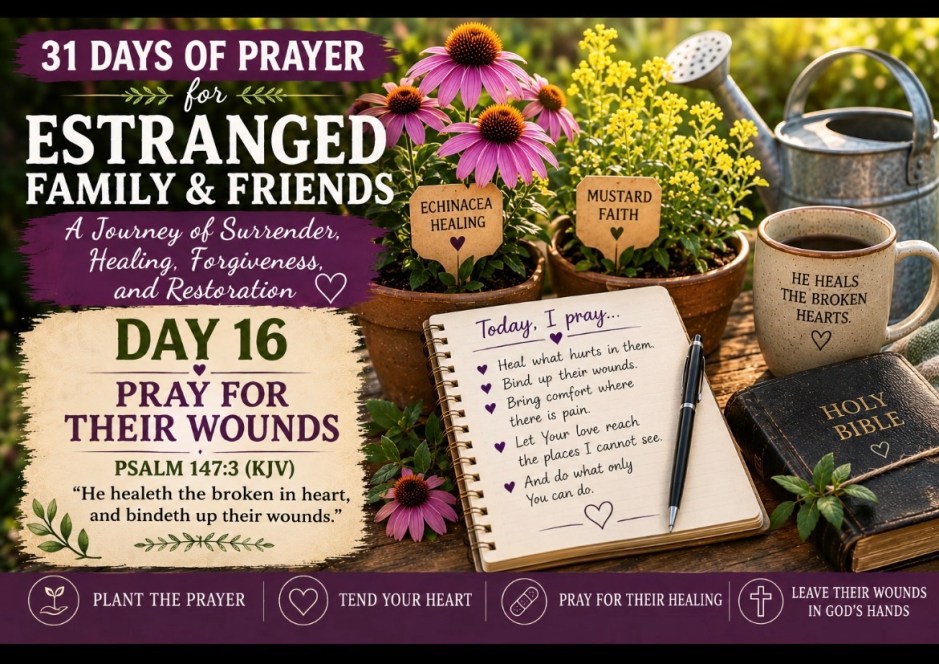
Scripture — Psalm 147:3 KJV
“He healeth the broken in heart, and bindeth up their wounds.”
Welcome back to 31 Days of Prayer for Estranged Family and Friends—a journey of surrender, healing, forgiveness, and restoration.
Yesterday, we prayed for something even more important than our loved one’s relationship with us.
We prayed for their relationship with God.
We asked:
“Father, draw them closer to You.”
Today, we’re going to pray for something we may not be able to see.
Their wounds.
Psalm 147:3 says:
“He healeth the broken in heart, and bindeth up their wounds.”
When someone has hurt us, it can be difficult to remember that they may be hurting too.
Their wounds don’t excuse the wounds they may have caused.
But perhaps today, instead of trying to understand everything they’ve done, we can simply pray:
“Father, heal the places in them that hurt.”
There May Be Wounds We Cannot See
One of the difficult things about estrangement is that we rarely know the entire story happening inside another person’s heart.
We know what they said.
We know what they did.
We know how their choices affected us.
But we may not know everything that shaped those choices.
Maybe they’re carrying childhood wounds.
Rejection.
Fear.
Shame.
Disappointment.
Grief.
A broken relationship we know nothing about.
Maybe there are wounds between us that we don’t completely understand.
Or perhaps they’re struggling with something entirely unrelated to us.
We don’t have to diagnose them.
We don’t have to assume we know why they behave the way they do.
And we certainly shouldn’t use someone’s wounds to excuse harmful behavior.
But we can acknowledge something very simple:
Every person carries places that need God’s healing.
Including them.
Including us.
Hurt People Still Have Responsibility
There’s an important balance here.
Compassion doesn’t mean pretending wrongdoing isn’t wrong.
Understanding that someone may be wounded doesn’t mean removing responsibility for their choices.
We can hold two truths at the same time:
“What happened hurt me.”
And…
“The person who hurt me may also need healing.”
That’s a powerful place to pray from.
Because now we’re no longer asking only:
“God, make them see what they did to me.”
We’re also asking:
“God, heal whatever is broken inside them.”
That’s not weakness.
That’s compassion.
And compassion can exist alongside truth, wisdom, and healthy boundaries.
“Bindeth Up Their Wounds”
I love the tenderness of Psalm 147:3:
“He healeth the broken in heart, and bindeth up their wounds.”
Think about the picture Scripture gives us.
God doesn’t simply point at the wound.
He binds it up.
There is care in those words.
Patience.
Gentleness.
Healing.
And notice something else:
It says He heals.
That’s important for those of us who desperately want to fix someone we love.
You are not their healer.
You may love them.
You may pray for them.
There may even be a day when God allows you to participate in their healing through an apology, a conversation, listening, or simply loving them well.
But ultimately…
God is the healer.
That’s incredibly freeing.
You don’t have to know how to repair every wound.
You can bring the wounded person to the One who does.
What If You Caused Some of the Wound?
And maybe this part is difficult.
What if some of the wounds we’re praying for…
were caused by us?
We’ve already spent time asking God to search our hearts.
We’ve talked about confession and asking forgiveness.
So today isn’t about drowning ourselves in guilt.
It’s simply about humility.
Perhaps we can pray:
“Father, if I contributed to their pain, heal the places I wounded.”
And if God gives us an opportunity to make something right, we can faithfully do our part.
But even after a sincere apology, we cannot demand that another person’s healing happen according to our timetable.
We can repent.
We can change.
We can make amends where appropriate.
And then we must allow God to tend wounds that only He can reach.
Returning to Our Echinacea
Today, I especially want us to look at our echinacea.
Throughout this entire journey, echinacea has represented healing.
And until now, perhaps we’ve mostly thought about healing for the relationship…
or healing for ourselves.
But today, let the echinacea represent their healing.
Maybe you could gently touch one of the leaves or tend the soil around the plant while saying:
“Lord, as I tend this plant, remind me that You are tending places in their heart that I cannot see.”
And beside it is our mustard.
Our reminder of faith.
It takes faith to pray for someone’s healing when they’ve hurt us.
It takes faith to want God to bless and restore someone even when they haven’t reconciled with us.
But that’s exactly the kind of faith we’re cultivating.
Today’s Action — Pray for the Wound, Not the Behavior
Take out your journal and write the person’s name.
Then underneath it write:
“Father, heal what hurts in __________.”
Don’t try to determine what their wounds are.
You don’t need to write:
They’re like this because…
or
They behave this way because…
We don’t know another person’s heart that completely.
Instead, simply pray:
“God, You know.”
If you know of a particular grief or wound they’ve experienced, you can certainly pray for it.
But otherwise, leave the details with God.
Then write:
“I release the need to understand every wound before I can pray for its healing.”
And today, every time you’re tempted to rehearse something painful they did, try turning it into prayer:
“Father, heal them.”
Today’s Prayer
Let’s pray.
Heavenly Father,
Your Word says:
“He healeth the broken in heart, and bindeth up their wounds.”
Today I bring __________ before You.
Father, You know every place in their heart that hurts.
You know wounds from their childhood.
You know disappointments they’ve carried.
You know rejection they’ve experienced.
You know grief they’ve never spoken about.
You know fears they may never have shared.
And You know every wound I know nothing about.
I don’t want to assume that I understand their heart.
But You do.
So Father, go where I cannot go.
Touch what I cannot touch.
Heal what I cannot heal.
Bind up the places that are broken.
Where there is fear, bring peace.
Where there is shame, bring truth.
Where there is rejection, remind them of Your love.
Where there is grief, bring comfort.
Where there is anger rooted in pain, bring healing beneath the anger.
Where there are wounds between us, Father, tend them gently.
And if I caused any of those wounds, give me humility to recognize what belongs to me.
Forgive me where I need forgiveness.
Change me where I need changing.
And if there is something appropriate for me to make right, give me wisdom and courage to do it.
But Father, remind me that I am not their healer.
I release that responsibility to You.
I cannot force healing.
I cannot rush it.
I cannot dig into another person’s heart to see whether progress is happening.
I can only love.
Pray.
Obey You.
And trust.
Today I ask You to heal __________ not simply so that they will return to me…
but because I love them and want them whole.
Even if I never receive credit for praying.
Even if I never see everything You do.
Even if their healing takes place somewhere far beyond my view.
Heal them, Father.
And continue healing me too.
Give me faith—even if it is only the size of a mustard seed—to believe that Your hands can reach wounds mine never could.
In the name of Jesus Christ,
Amen.
Before we finish today, look once more at our echinacea.
Today it carries a particularly beautiful reminder:
Healing isn’t only something we’re asking God to do for us.
We’re asking Him to heal them too.
The echinacea reminds us:
God heals.
The mustard reminds us:
We can trust Him to do what we cannot.
And the garden reminds us that some of the most important work happens where human eyes cannot see.
Underneath the surface.
At the root.
So today, when you think about what this person has done…
try also remembering that there may be wounds you know nothing about.
You don’t have to understand them.
You don’t have to excuse wrongdoing.
You simply have to know Who the Healer is.
And then pray:
“Father, heal what hurts in them.”
Plant the prayer. Tend your heart. Pray for their healing. Leave their wounds in God’s hands. And trust Him with the growth.
And as always,
may your roots grow deep and your spirit stay nourished.
God bless you, and I’ll see you tomorrow.

