
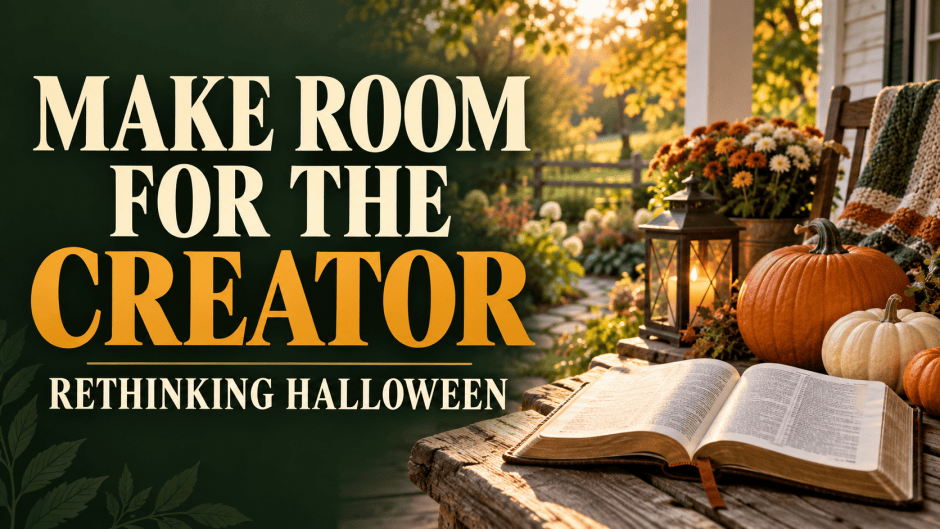
Pip: Welcome back to Pollywog’s Place — where the questions worth asking tend to start in the kitchen and end in Scripture.
Mara: Susie at Pollywog’s Place Blog has been thinking hard about what we let into our homes and why, and today we’re following that thread — through seasonal rhythms, family habits, and what it looks like to build a new normal on purpose.
Pip: Let’s start with the question that kicks the whole thing off.
One Season at a Time: Making a New Normal in Our Home
Pip: The core tension here is deceptively simple: are we choosing the rhythm of our home, or just going along with whatever the calendar hands us next?
Mara: The post frames it exactly that way. Here’s the line that sets the whole thing up: “Are we prayerfully choosing the rhythm of our home, or simply following whatever comes next?”
Pip: And that question doesn’t stay contained to Halloween. Once you ask it once, you start asking it about everything — what you watch, what you display, what you hand your kids without thinking.
Mara: Right, and the post is honest that these convictions didn’t arrive all at once. The framing is explicitly personal: “These convictions have grown over time. Things I once accepted without much thought have started to trouble me.”
Pip: Which matters, because this isn’t a lecture from someone who always had it figured out.
Mara: The anchor verse is First Thessalonians 5:21 through 22 — “Prove all things; hold fast that which is good. Abstain from all appearance of evil.” That instruction to examine everything is what drives the practical sections that follow.
Pip: And the examination gets specific. Grocery store displays, horror movies, haunted houses — the argument is that representations of cruelty have become so ordinary we’ve stopped noticing them.
Mara: Philippians 4:8 comes in here, directing thoughts toward what is true, honest, just, pure, and lovely. The post turns that into a household question: what are we feeding our thoughts, and what are our children absorbing?
Pip: The store rushing eggnog onto shelves before mid-October is almost a comic illustration of the larger point — but it’s a real one.
Mara: Romans 12:2 follows that observation directly: “And be not conformed to this world: but be ye transformed by the renewing of your mind.” The practical upshot is stated plainly — the store’s calendar doesn’t have to become your family’s calendar.
Pip: From there the post gets genuinely useful — working through decor, entertainment libraries, how to explain your choices to relatives without it becoming a confrontation.
Mara: The suggested language for those conversations is careful. When someone says “but you used to do it,” the response is simply: “That’s true. I haven’t always felt this way. As I’ve studied and reflected, my understanding has changed.”
Pip: No defensiveness, no judgment of anyone else’s choices — just an honest account of a mind that changed.
Mara: The post also suggests gathering around the biblical feasts, particularly Sukkot, as an alternative focus for the season — shared meals, Bible study, and community rather than a replacement event that has to be organized and performed.
Pip: Simple alternatives for Halloween evening include making soup, baking pumpkin bread, writing encouragement cards. The point isn’t to fill the slot with something equally elaborate — it’s to make room for what actually matters.
Mara: And it closes where it started: one season at a time, one meal, one conversation, one thoughtful decision. The change is cumulative, not overnight.
Pip: The question underneath all of this is a quiet one — not what the calendar says is next, but what we actually want to be ordinary in our homes.
Mara: One season at a time is a patient way to get there.

