
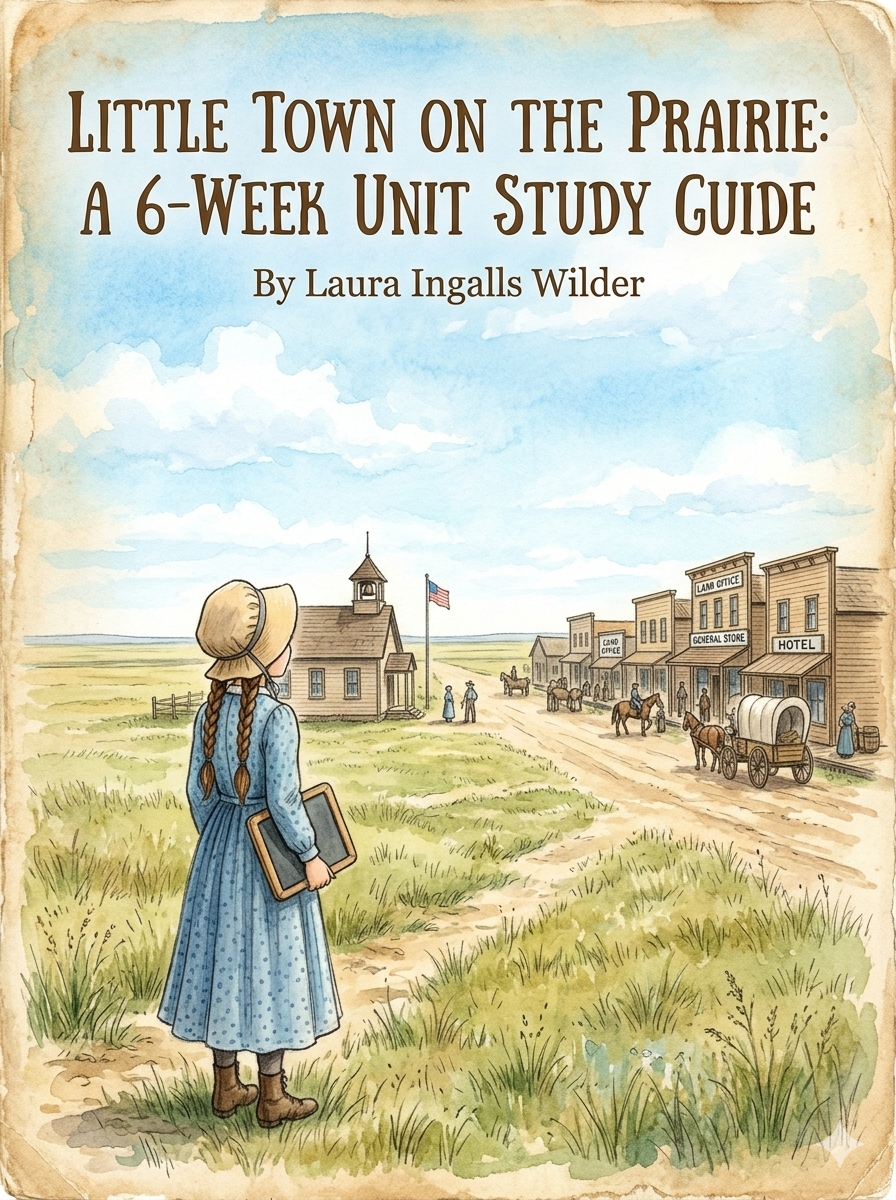
If your family fell in love with the high-stakes survival story of the Dakota blockades, then returning to the prairie as spring blooms is an absolute joy. In our homeschool, moving from the dark winter months into the bright, bustling pages of Little Town on the Prairie by Laura Ingalls Wilder** marked a beautiful transition—not just for the landscape, but for Laura herself. Seeing a fifteen-year-old Laura step up to take her first job sewing shirts in town sparked incredible family discussions about maturity, work ethic, and community duty. If you’re ready to channel that reading excitement into a complete, rigorous academic plan, here is our comprehensive 6-week unit study designed to turn this beloved classic into a hands-on learning adventure for your middle schooler.
**As an Amazon Associate, I earn from qualifying purchases. This post does contain some affiliate and/or referral links to products and/or services that we use. If you happen to click through a link and make a purchase, we may earn a teensy-weensy small commission (at NO EXTRA cost to you) if a purchase is made through these links. These links help to support our family, our blog, and our homeschooling mission. This means that we can keep bringing you great recipes, ideas, and tips for FREE! Click HERE for a full disclaimer. –Thank you!
Mornings:
We start every morning off with our prayers and the Pledge of Allegiance. Below is a video of how we start our mornings.
Don’t have a flag? Grab one HEREand print it out to put up somewhere… you could even let the kids make a flag to proudly display. Amazon also has some little ones like this one HERE and HERE.
Tip: If you want to go to a certain week/chapter or topic simply push the ‘ctrl’ and the ‘F’ button down together and a small bar will pop up. Type in the week number or chapter number you want and it will take you to it.
Little Town on The Prairie Unit Study Teacher Answer Key
Week 3: Back to School & Conflicts (Chapters 9–13)
Reading Schedule:
- Day 1: Ch. 9 (Blackbirds)
- Day 2: Ch. 10 (The Schoolroom)
- Day 3: Ch. 11 (Miss Wilder’s Choice)
- Day 4: Ch. 12 (Snug for Winter) & Ch. 13 (School Days)
Language Arts
Vocabulary:
- Commotion
- Rebellious
- Subduing
- Melancholy
- Persistent
- authority
Discussion Question:
- Analyze the conflict between Miss Wilder (the teacher) and the older schoolboys. How could communication changes have de-escalated the classroom disruption?
Writing Activity: Write a poem reflecting on the monotonous rhythmic sound of blackbirds swarming an open agricultural grain field.
The Classroom Conflict Resolution Script: Miss Wilder relies on strict, uncompromising authority demands, which causes a rebellious commotion among the older students. You are the peer mediator. Write a 2-page dramatic script rewriting the argument in Chapter 11. Your dialogue must show how using de-escalation techniques (active listening, neutral I-statements, and clear compromise boundaries) could transform a chaotic classroom disruption into a productive compromise.
Optional Activities:
Math Word Problem
Problem: A swarm of blackbirds destroys a local wheat field. On day one, they consume 15 pounds of grain. If their consumption rate doubles every consecutive day for 4 straight days, how many total cumulative pounds of grain will be destroyed by the end of day four? (See the instructions at the end of the lesson plan.)
Optional Activities:
- Beginning Fractions & Decimals by Rock ‘N Learn
- Bubble Pop! Math Challenge Games – Gr. 3‑4
- CoolMath4Kids
- PBS Kids Games
Geography & History
Topic: The evolution of the American One-Room Schoolhouse. Study the rules, multi-age classroom setups, and strict social structures that dictated 19th-century public education.
Optional Activities:
Science
Topic: Avian migration behaviors and pest dynamics. Research the biological swarming traits of blackbirds and explore how early farmers defended crops prior to synthetic pest options.
Optional Activities:
- Mystery Science
- All About Life Science Activities
- National Geographic Match the Fact Cards
- National Geographic Kids What Animal Am I Card Game
Life Skills & Labs
Insulation Lab Check (Science Integration): Track how modern windows hold warmth inside a schoolhouse compared to the primitive window seals and coal stove setups used in pioneer public buildings.
Optional Activities:
- Plain and Not So Plain Home Economics Course (she has other subjects as well)
PE, Health & Safety
Topic: Posture and ergonomics in the classroom. Pioneer children sat on hard wooden benches for long stretches. Design a physical core-stretching routine to manage proper structural posture while studying inside.
Art, Music & Crafts
Topic: Slateboard design. Try utilizing an authentic slate tile board or a chalkboard to complete math drills and cursive penmanship work, replicating classic pioneer methods.
Math Word Problem
Mapping Grids
Part 1: Background & Reading Connection
In Chapter 9, an immense, swirling cloud of red-winged blackbirds descends upon Pa’s beautiful field of oats on the homestead claim. Laura describes the sound of their wings like a rushing river, and within minutes, thousands of birds are stripping the grain right out of the hulls.
For a pioneer family, an unchecked wildlife swarm was a financial and physical disaster. If the birds destroyed the grain crop, Pa would lose his primary source of income and the feed needed to keep their horses and livestock alive through the coming winter.
Today, you will use coordinate graphing grids and exponential math modeling to map out the destruction pattern of a bird swarm and calculate exactly how fast a small problem can multiply on an open farm field.
Part 2: Mapping the Field Coordinate Grid
Pa’s oat field can be mapped out as a four-quadrant coordinate plane. The center of the field where Pa stands with his gun is the origin (0,0). Each grid line unit on your graph paper represents exactly 10 yards.
Using a blank sheet of grid paper, draw a vertical y-axis and a horizontal x-axis. Number the lines from -5 to 5 on both axes. Plot the following structural landmarks on your grid:
Point P (Pa’s Location): Plot a point at the origin (0,0).
Point S (The Claim Shanty): Plot a point at coordinates (-4, 3).
Point W (The Water Well): Plot a point at coordinates (2, -3).
Point B (The First Swarm Landing Site): Plot a point at coordinates (4, 2).
Grid Coordinate Questions:
In which quadrant did the blackbirds first land? (Quadrant I, II, III, or IV?)
________________________________________________________________________
If Pa (0,0) walks directly to the Water Well (2, -3), how many total grid units east (right) and how many grid units south (down) must he walk?
Units East: ____________
Units South: ____________
Part 3: The Exponential Destruction Grid
Once the blackbirds land at Point B, they begin consuming grain at an alarming exponential rate. On Day 1, the small scout flock consumes exactly 15 pounds of oats before Pa scares them off. However, they return the next day with reinforcements, causing the total weight of destroyed grain to double every single day for 4 consecutive days.
Fill out the exponential growth table below to track the destruction layout:
Day Sequence
Mathematical Operation
Daily Grain Destroyed (lbs)
Cumulative Total Grain Eaten (lbs)
Day 1
Baseline Starting Amount 15 lbs
Day 2
15 \times 2
____________ lbs
____________ lbs
Day 3
{Previous Day’s Weight} \times 2
____________ lbs
____________ lbs
Day 4
{Previous Day’s Weight} \times 2
____________ lbs
____________ lbs
Graphing the Growth Curve: On a small side-axis on your graph paper, plot your results. Let the horizontal x-axis represent Time (Days 1–4) and the vertical y-axis represent Cumulative Grain Eaten (0 to 250 lbs). Connect the points. Is your line a perfectly straight diagonal line (linear), or does it curve sharply upward (exponential)?
________________________________________________________________________
📝 Part 4: Analytical Word Problems
Apply your calculations from the math grids to solve these real-world pioneer dilemmas.
The Cost of Loss: Pa planned to sell his surplus oat crop to the town grain elevator for $0.40 per pound. Based on your cumulative total from Day 4 in the table above, calculate the total amount of money Pa lost because of the blackbird raid.
Show your equation setup: ___________________________________________
Final Dollar Loss: ____________
Rationing Adjustments: Before the swarm, Pa had 600 pounds of grain stored for the winter. Deduct your cumulative Day 4 loss from his 600-pound stack. If his two horses, Sam and David, consume a combined total of 15 pounds of grain per week, calculate how many full weeks of feed Pa has left for his team.


One thought on “Little Town on The Prairie Unit Study Week 3”