Podcast Episode 03: Biblical Worth, Home, And Cherished Women

Pip: Welcome to Pollywog’s Place Blog — where the questions are ancient and the stakes are genuinely personal.

Mara: Susie at Pollywog’s Place Blog has been writing about things that actually matter at home and in the heart — what it means to know your own worth, and what it looks like to tend a household with intention. Let’s start with identity and what scripture says you deserve.

Biblical Worth And Identity

Mara: The posts in this segment are asking a question that sounds simple but cuts deep: do you actually believe you are worth something, and does that belief shape who you let into your life?

Pip: The anchor text opens with Proverbs 3:15, and then the post speaks directly to daughters: “You deserve to be loved, but not just loved like the general idea of love, you deserve to be cherished.”

Mara: That distinction matters. The post is not talking about settling for affection that shows up occasionally — it is talking about being someone’s active priority, the person they protect and keep in their thoughts.

Pip: And the post is practical about it. Don’t chase, don’t lower your standards to accommodate someone else’s excuses, and don’t assume you can change a person — that kind of change, the post argues, comes from above, not from patience or pressure.

Mara: The companion piece, “Cherished,” works through exactly what that word means in practice. It defines cherishing as making another person your priority relationship — shown through daily small acts, touch, listening, encouragement, and showing respect in public as well as in private.

Pip: So the two posts are really one argument in two directions: know what you deserve, and then actually demonstrate it when you’re in a relationship.

Mara: That thread — worth informing behavior, not just self-esteem — carries right into how those values play out inside a home.

Home And Family Stewardship

Pip: If the first segment was about knowing your value, this one is about what you do with it once you’re building a life — specifically, what it means to take a home seriously as a responsibility, not just a location.

Mara: “Keeper of The Home” opens with Proverbs 24:3-4, then states the core claim plainly: “We are responsible for our homes and that our homes and families should be a priority for us. It means that we are each responsible for setting the tone of our homes.”

Pip: Setting the tone. That is a bigger job than it sounds — it covers what comes in, what goes out, whether people inside feel safe, and whether guests find rest there.

Mara: The post is also honest about the gap between the ideal and the reality. It names the experience of being a single mother working multiple part-time jobs and still holding the household’s emotional climate as the first priority. The practical sections — meal planning, cleaning routines, budgeting, time management — are offered as tools, not judgments.

Pip: It reads less like a lifestyle prescription and more like someone handing you the manual they wish they’d had at twenty-two.

Mara: The post closes by framing all of it as intentional work. A keeper of the home is not something you drift into — it is a decision made deliberately, then built on through routines, prayer, and the goal of passing those habits forward to the next generation.

Pip: Worth knowing. Cherished at home.


Mara: Both threads come back to the same idea — that what you believe about your value shapes everything downstream, from the relationships you accept to the household you build.

Pip: And apparently the work is never quite finished. Next time, more from Pollywog’s Place.

You can read these posts HERE:
Cherished

You are worth more than rubies

Keeper of the Home

Walking in SELF-CONTROL Devotional

I am hoping to make a new devotional for each month this year… that’s a big challenge, but it is something that has been on my heart. For JULY, our monthly theme will be SELF-CONTROL. We will be trying to find ways to show a little more SELF-CONTROL through routines and habits.

Here is the FREE printable, if you’d like to join us:

Continue reading “Walking in SELF-CONTROL Devotional”

The Simple Joys of Slow Living: Have you ever heard of Rabbit ‘Rithmetic?

There are so many simple joys that can be found when we embrace the concept of ‘slow living’ which we are trying our best to do around here.

This month has been full of adventures here at home and away. We just never know what to expect. Our area has been experiencing a severe drought so that made gardening a little more challenging this season. We have been so blessed to get a decent amount of rain lately and I don’t complain about it, even when it happens mid harvest!

Continue reading “The Simple Joys of Slow Living: Have you ever heard of Rabbit ‘Rithmetic?”

Special Holiday Meals: Christmas in July

We haven’t really celebrated this, but it might be a fun idea to do. I know that in North Carolina, some places had festivals around this time of year, and they were always a lot of fun.

CHRISTMAS IN JULY
Smoked, BBQ, or Roasted Turkey
Corn CasseroleCarrot Souffle
Smoked Salmon DipStuffed Tomatoes – these can also be stuffed with chicken or tuna salad
Watermelon Trees & Strawberry Santas

Continue reading “Special Holiday Meals: Christmas in July”

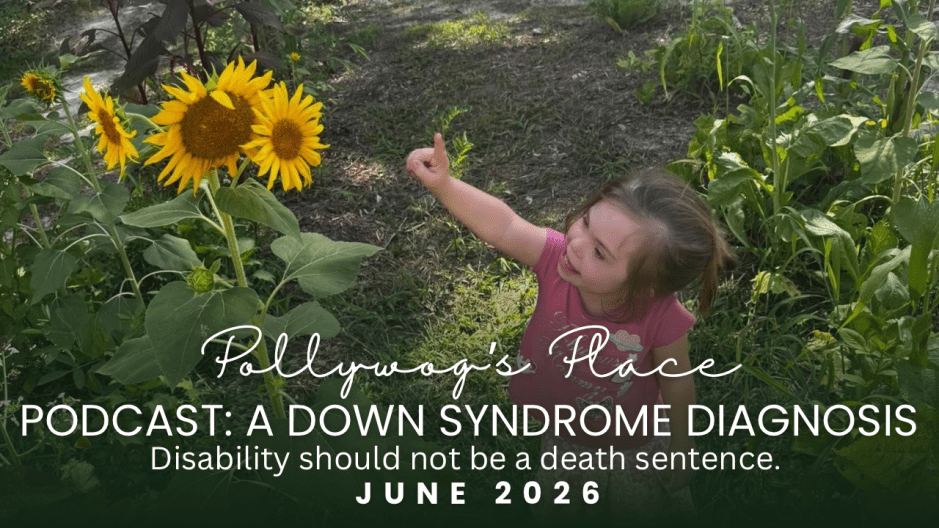
Podcast Episode 01: Down Syndrome shouldn’t be a death sentence

Pip: Welcome to Pollywog’s Place Blog — where the posts are personal, the stakes are real, and nobody is pulling punches.

Mara: Susie at Pollywog’s Place Blog wrote something this week that takes on prenatal diagnosis, medical pressure, and what it actually looks like to say no — repeatedly — when doctors are certain they know better.

Pip: Let’s start with that story.

Down Syndrome Shouldn’t Be a Death Sentence

Mara: The post opens a question that cuts to the bone: when a prenatal diagnosis arrives loaded with worst-case projections, who actually gets to decide what a child’s life is worth?

Pip: The answer, in this case, came appointment after appointment, and it was the same every time. Here’s the line that captures the whole experience: “At every MFM appointment I was asked if I was ready to schedule ‘the procedure’ — I was told that it would be simple, we could try again in a couple of months, and this was just a rare occurrence that we wouldn’t have to worry about happening again.”

Mara: What that means in practice is that the medical framing wasn’t neutral. It was a campaign. The word “procedure” does a lot of work when you use it to describe ending a pregnancy — it flattens the decision into something routine.

Pip: And the pressure didn’t stop at clinical language. Two weeks before the birth, she was told she was being selfish for refusing. That’s not a medical opinion — that’s something else entirely.

Mara: The post is careful to say it isn’t condemning anyone who has faced this choice differently. But it does make a pointed argument: doctors were presenting opinions as facts. They said Shyanne would never walk, would never have a happy life, would be a burden to her other children. Post-birth genetic testing couldn’t even fully confirm the original diagnoses.

Pip: They called it a rare occurrence that wouldn’t happen again — which is a remarkable thing to say about a child who was, at that moment, doing somersaults.

Mara: She frames the core message plainly: “A disability should not be a death sentence for any child who hasn’t even had the chance to live yet.” And she points toward adoption as a real alternative for families who feel unequipped, noting there are communities and support groups that offer something a single genetics appointment simply cannot — time, experience, and people who have actually been there.

Pip: Shyanne defied every projection. She’s described as healthy, active, and, to use the post’s own words, able to light a room.

Mara: The post ends where it began — with faith, and with the insistence that fear of uncertainty is not the same thing as information.


Pip: One post, one family’s experience — and it raises something that stays with you.

Mara: When the data runs out, the question of who decides is still very much open.

You can read the post HERE:

Down Syndrome shouldn’t be a death sentence