
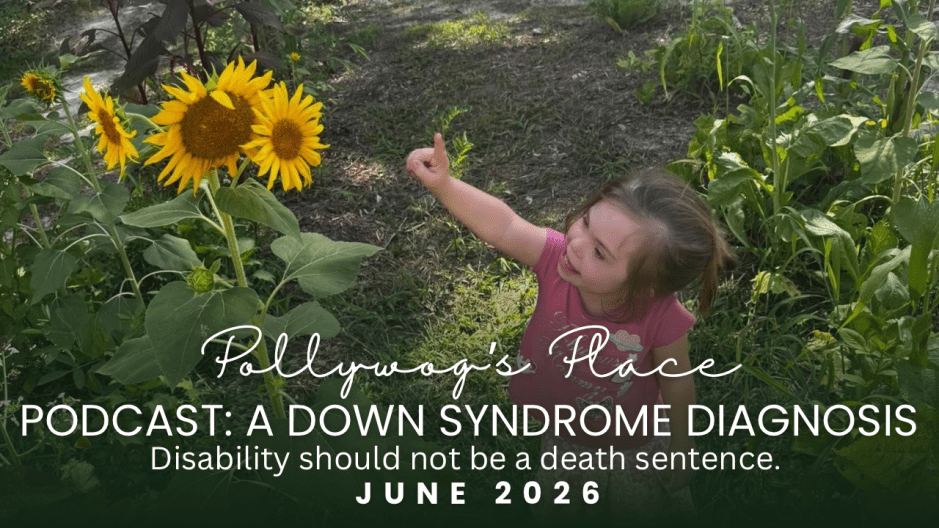
Pip: Welcome to Pollywog’s Place Blog — where the posts are personal, the stakes are real, and nobody is pulling punches.
Mara: Susie at Pollywog’s Place Blog wrote something this week that takes on prenatal diagnosis, medical pressure, and what it actually looks like to say no — repeatedly — when doctors are certain they know better.
Pip: Let’s start with that story.
Down Syndrome Shouldn’t Be a Death Sentence
Mara: The post opens a question that cuts to the bone: when a prenatal diagnosis arrives loaded with worst-case projections, who actually gets to decide what a child’s life is worth?
Pip: The answer, in this case, came appointment after appointment, and it was the same every time. Here’s the line that captures the whole experience: “At every MFM appointment I was asked if I was ready to schedule ‘the procedure’ — I was told that it would be simple, we could try again in a couple of months, and this was just a rare occurrence that we wouldn’t have to worry about happening again.”
Mara: What that means in practice is that the medical framing wasn’t neutral. It was a campaign. The word “procedure” does a lot of work when you use it to describe ending a pregnancy — it flattens the decision into something routine.
Pip: And the pressure didn’t stop at clinical language. Two weeks before the birth, she was told she was being selfish for refusing. That’s not a medical opinion — that’s something else entirely.
Mara: The post is careful to say it isn’t condemning anyone who has faced this choice differently. But it does make a pointed argument: doctors were presenting opinions as facts. They said Shyanne would never walk, would never have a happy life, would be a burden to her other children. Post-birth genetic testing couldn’t even fully confirm the original diagnoses.
Pip: They called it a rare occurrence that wouldn’t happen again — which is a remarkable thing to say about a child who was, at that moment, doing somersaults.
Mara: She frames the core message plainly: “A disability should not be a death sentence for any child who hasn’t even had the chance to live yet.” And she points toward adoption as a real alternative for families who feel unequipped, noting there are communities and support groups that offer something a single genetics appointment simply cannot — time, experience, and people who have actually been there.
Pip: Shyanne defied every projection. She’s described as healthy, active, and, to use the post’s own words, able to light a room.
Mara: The post ends where it began — with faith, and with the insistence that fear of uncertainty is not the same thing as information.
Pip: One post, one family’s experience — and it raises something that stays with you.
Mara: When the data runs out, the question of who decides is still very much open.
You can read the post HERE:

