
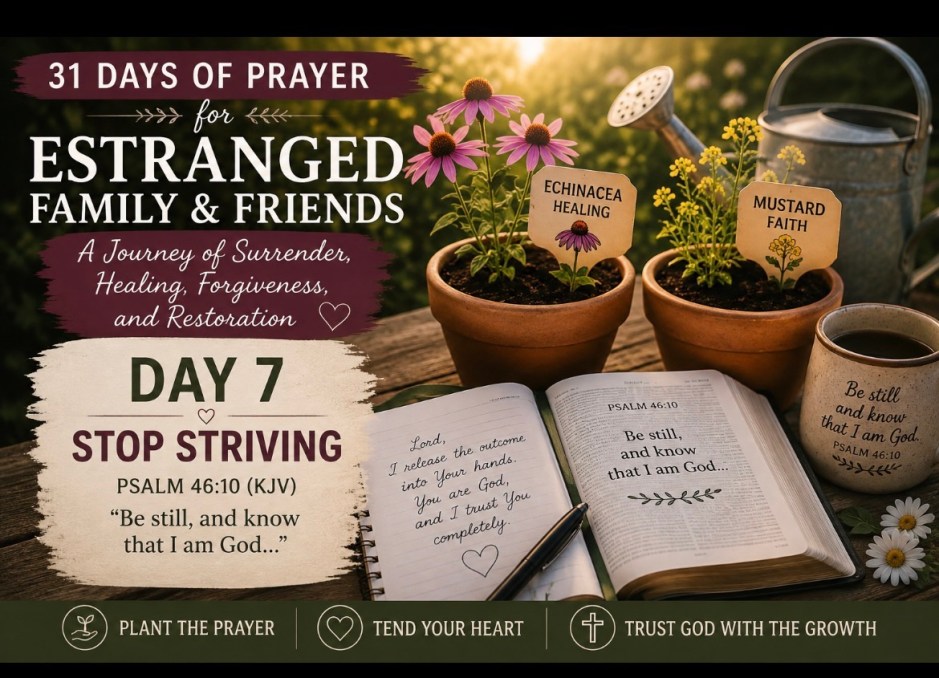
Scripture — Psalm 46:10 KJV
“Be still, and know that I am God…”
Welcome back to 31 Days of Prayer for Estranged Family and Friends—a journey of surrender, healing, forgiveness, and restoration.
We’ve reached Day Seven and the end of our first week together.
This week, we’ve planted prayers.
We’ve placed the people we love into God’s hands.
We’ve practiced trusting what we cannot see.
We’ve invited God to search our own hearts.
We’ve released some of our need to be right.
We’ve begun giving God the past.
And yesterday, we allowed ourselves simply to say:
“Lord, I miss them.”
We’ve done a lot of heart work this week.
So today, we’re going to do something that can sometimes feel harder than all of those things.
We’re going to stop.
Our Scripture for today is Psalm 46:10:
“Be still, and know that I am God…”
Today is about learning to stop striving and allowing God to be God.
When Love Turns Into Striving
When someone we love is estranged from us, doing nothing can feel almost unbearable.
We think:
Maybe I should send another message.
Maybe I should explain myself one more time.
Maybe if I find exactly the right words, they’ll understand.
Maybe I should ask someone else to talk to them.
Maybe I should check their social media.
Maybe I should try one more thing.
Sometimes action is appropriate.
There are times when God calls us to speak, apologize, reach out, make amends, or take a step toward peace.
But there are also times when we’ve done what we can do.
And continuing to push isn’t faithfulness anymore.
It becomes striving.
Striving says:
“If I don’t make something happen, nothing will happen.”
Faith says:
“I will faithfully do what God gives me to do—and I will trust Him with what belongs to Him.”
Be Still
Psalm 46:10 says:
“Be still, and know that I am God.”
Those words contain both an instruction and a reminder.
Be still.
And…
Know that I am God.
Maybe part of the reason stillness is so difficult is because when we stop moving, we have to acknowledge how little control we actually have.
I cannot control another person’s thoughts.
I cannot control whether they forgive me.
I cannot control whether they understand my intentions.
I cannot control whether they answer my message.
I cannot control whether they are ready for reconciliation.
And I certainly cannot control their heart.
But I know the One who sees it.
So perhaps stillness is one of the greatest expressions of surrender.
It’s saying:
“God, I recognize where my responsibility ends and Yours begins.”
What Our Seeds Are Teaching Us
Look at our echinacea and mustard.
The echinacea reminds us that we’re praying for healing.
The mustard reminds us to have faith—even if that faith feels only as small as a mustard seed.
We’ve planted them.
We’ve watered them.
We’ve made sure they have what they need.
But there’s something we haven’t done.
We haven’t made them grow.
We can’t.
I can stand here all afternoon staring at these pots, but my staring won’t make a seed germinate.
I could become impatient and pour more and more water into the soil—but eventually, instead of helping the seed, I could harm it.
I could dig into the soil every morning to see whether roots have formed—but in trying to check the progress, I might disturb the very growth I’m hoping for.
There comes a point when the gardener has to step away.
We’ve planted.
We’ve watered.
We’ve tended.
And now…
we wait.
Maybe there’s something in your life today that needs the same treatment.
Not Every Closed Door Needs Another Knock
I want to give you a sentence to carry with you today:
Not every closed door needs another knock today.
Sometimes love reaches out.
Sometimes love waits.
Sometimes faith speaks.
Sometimes faith becomes quiet.
And sometimes surrender means resisting the urge to do something simply because doing something makes us feel more in control.
If you’ve sincerely apologized, perhaps you don’t need to apologize fifteen more times hoping they’ll finally respond.
If you’ve told someone you love them and the door is open, perhaps you don’t need to remind them every few days.
If someone has asked for space, honoring that space may itself be an act of love.
And if God does prompt you to take action, you can take it.
But we want our actions to come from peace and obedience, not panic and fear.
Rest Is Not Giving Up
Being still does not mean that we’ve stopped caring.
Waiting doesn’t mean we’ve abandoned hope.
And surrender isn’t the same thing as giving up.
We’re still praying.
We’re still loving.
We’re still allowing God to work in us.
We’re simply releasing the belief that the outcome depends entirely upon us.
Maybe you’ve been carrying this relationship like something you have to keep alive with your own hands.
Today, you can put it down.
God doesn’t need you awake all night worrying in order for Him to remain at work.
He doesn’t need you rehearsing every possible conversation.
He doesn’t need you checking constantly for signs of change.
You are allowed to rest.
The Difference Between Waiting and Doing Nothing
Biblical waiting isn’t necessarily passive.
While we wait for something we cannot control, God can still give us plenty to tend.
We can tend our relationship with Him.
We can tend our homes.
We can tend the relationships that are presently in our lives.
We can tend our character.
We can serve.
We can forgive.
We can grow.
We can pray.
And we can live.
Estrangement can consume so much emotional energy that our whole lives begin revolving around the person who isn’t there.
But God has still given us a life to faithfully live today.
Don’t become so focused on the relationship you’re waiting to have restored that you stop tending the blessings God has already placed around you.
Today’s Action — Practice Stillness
Today’s action may sound simple.
But it might be one of our hardest yet.
Don’t try to change anything today.
Unless there is a genuine responsibility that requires your attention, give yourself one day without trying to move the relationship forward.
Don’t send the message simply because anxiety tells you to.
Don’t check for signs.
Don’t rehearse the argument.
Don’t try to figure out how everything will be restored.
Instead, find a quiet place.
Maybe it’s beside the garden.
Maybe it’s on your porch.
Maybe it’s simply a chair by a window.
Set aside a few minutes and sit quietly before God.
You don’t even need a long prayer.
Just breathe and repeat:
“Be still, and know that I am God.”
And then:
“Father, I trust You to work while I rest.”
If you’re journaling with us, write that sentence today:
“I trust God to work even when I am still.”
Today’s Prayer
Let’s pray.
Heavenly Father,
Your Word says,
“Be still, and know that I am God.”
Father, I confess that being still is difficult for me.
I want to fix what is broken.
I want answers.
I want movement.
I want reassurance.
And sometimes I keep reaching for things You are asking me to release.
Teach me the difference between obedience and striving.
Show me when to speak and when to remain quiet.
Show me when to reach out and when to wait.
Keep fear from disguising itself as faithfulness.
Keep anxiety from convincing me that everything depends upon me.
Father, today I place __________ into Your hands again.
I cannot control their heart.
I cannot control their choices.
I cannot control their timing.
But You see what I cannot see.
You know what I cannot know.
And You can go where I cannot go.
So today, I stop striving.
Where I have faithfully done what You asked me to do, help me leave the results with You.
If there is something You truly want me to do, make it clear and give me wisdom to obey.
But if You are asking me to wait, give me grace to wait without fear.
While I wait, tend my heart.
Grow patience in me.
Grow peace in me.
Grow wisdom in me.
Grow faith in me.
Let my roots go deeper into You.
And Father, remind me that my life does not have to stop while I wait for this relationship to change.
Help me notice the people who are here.
The work You have given me.
The blessings surrounding me.
The life that is still happening today.
I choose to trust You.
I choose to rest.
I choose to be still.
And I choose to remember:
You are God, and I am not.
Give me faith—even if it is only the size of a mustard seed—to leave this person and this situation in Your hands.
In the name of Jesus Christ,
Amen.
Closing — End of Week One
And with that, we’ve completed our first week together.
Seven days ago, we planted these seeds.
The echinacea has reminded us to pray for healing.
The mustard has reminded us that even very small faith can be brought faithfully before God.
And perhaps the most important growth this week hasn’t been what we’ve seen above the soil.
Maybe some roots have been growing in us.
We’ve practiced surrender.
Trust.
Self-examination.
Gentleness.
Releasing the past.
Grieving with God.
And now…
being still.
So today, don’t dig up the seed.
Don’t pull on the plant to make it grow faster.
Don’t force the door.
Simply tend what God has placed in your hands and leave the growth with Him.
As we move into Week Two, we’ll begin looking more deeply at forgiveness and healing, starting tomorrow with Day Eight: Choosing Forgiveness.
But for today…
rest.
Plant the prayer. Tend your heart. Be still. And trust God with the growth.
And as always,
may your roots grow deep and your spirit stay nourished.
God bless you, and I’ll see you tomorrow.

