Why would we welcome things into our homes for one day that we wouldn’t want influencing our lives throughout the rest of the year?
If something would trouble us in February or June, what changes when October arrives?
That question is part of why our family is choosing not to celebrate Halloween. But the more I consider it, the more I realize this reaches beyond one holiday.
Sometimes it feels as though the world is taking over our thoughts, lives, and homes one season at a time. There is always something we’re encouraged to buy, display, watch, or participate in.
I’ve started asking myself: Are we prayerfully choosing the rhythm of our home, or simply following whatever comes next?
I Haven’t Always Felt This Strongly
These convictions have grown over time.
Things I once accepted without much thought have started to trouble me. Recently, I’ve felt more and more convicted, and changes are being made in our lives.
We’re reconsidering what we celebrate, what we watch, how we decorate, and what receives our attention.
We don’t have everything figured out. Changing familiar habits can be uncomfortable, especially when those habits hold childhood memories.
But I don’t want to ignore a growing conviction simply because continuing as we always have would be easier.
I’m sharing this as someone whose own heart and habits are changing.
Pip: Welcome to Pollywog’s Place Blog, where the lesson plans are many, the paper planners are endangered, and somebody is always overdue for grading.
Mara: Susie at Pollywog’s Place Blog has been writing about the practical side of homeschooling a large family — specifically how to keep records, schedules, and lesson plans from becoming a second full-time job. That’s the territory we’re covering today, starting with how she organizes everything behind the scenes.
Keeping Homeschool Records Without Losing Your Mind
Pip: Managing a homeschool for multiple children means the administrative side — grades, attendance, transcripts, book lists — can quietly become as demanding as the teaching itself. The question is whether there’s a system that actually holds all of it together.
Mara: The post “From Daily Lessons to Transcripts: How I Organize Our Homeschool” puts it plainly: “I can keep track of our lessons, grades, volunteer hours, book lists, and attendance all in one place instead of trying to piece everything together from notebooks, planners, and spreadsheets.”
Pip: So the upshot is: one consolidated record means that when a high schooler needs a transcript, you’re not reconstructing years of work from scattered notes and memory.
Mara: Right — and the post is specific about that payoff. Two children have already graduated, and the colleges accepted those transcripts. The drag-and-drop scheduling and independent task check-off for students are called out as features that reduce the daily friction of keeping those records current in the first place.
Flexibility as the Core Feature
Pip: Record-keeping is one thing, but a system that can’t bend when life intervenes is just a fancier way to fall behind. The real test is what happens when the schedule needs to change on short notice.
Mara: “Homeschool Organization. Simple. Flexible.” describes exactly that scenario: “Homeschool Manager also gives us the flexibility to adapt and reorder our school year as needed when life throws us an unexpected curve ball or two.”
Pip: What this means in practice is that a spontaneous field trip or a week off track doesn’t orphan the whole planner — you drag the task to a new slot and keep moving.
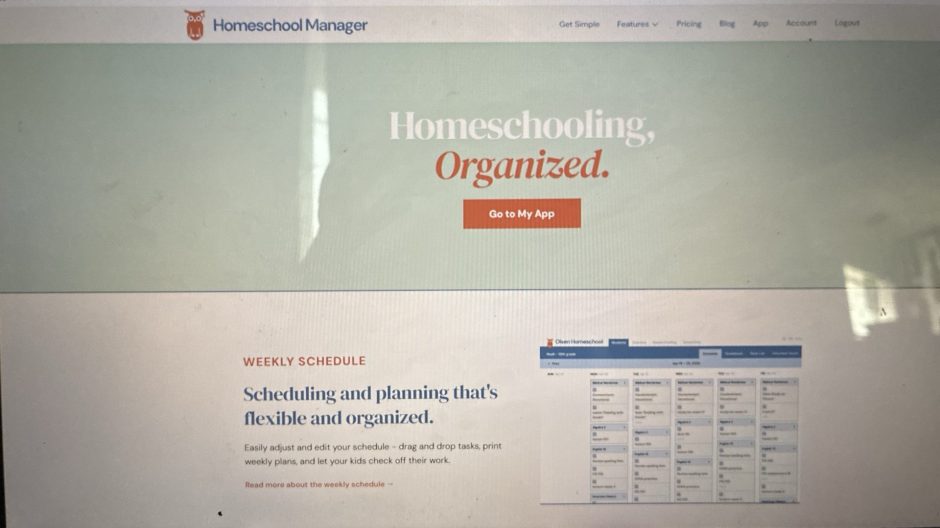
Mara: The post goes into real detail on how that works. The drag-and-drop feature lets you grab a lesson and move or copy it in seconds, replacing what used to be hours of rewriting paper schedules. Before finding the tool, paper planners kept getting abandoned because falling behind made them impossible to salvage.
Pip: Paper planners as a sunk cost — honestly a relatable tragedy.
Mara: The post also highlights the Notes section as a solution for pulling lessons from multiple curricula, which is common in eclectic homeschooling. Web addresses for videos, games, activities — all stored alongside the schedule so nothing gets lost between planning and teaching. Printable weekly schedules let older students work ahead independently, and the dashboard flags overdue or ungraded tasks at a glance.
Mara: Portfolio requirements vary widely by state, and the post points out that having grades, attendance, and completed work already logged makes assembling one straightforward rather than a project in itself.
Pip: The through-line across both posts is the same: the administrative side of homeschooling is real work, and a system that bends with your family makes more space for the actual teaching.
Mara: Next time we’ll see what else is on the Pollywog’s Place agenda — there’s always more ground to cover.