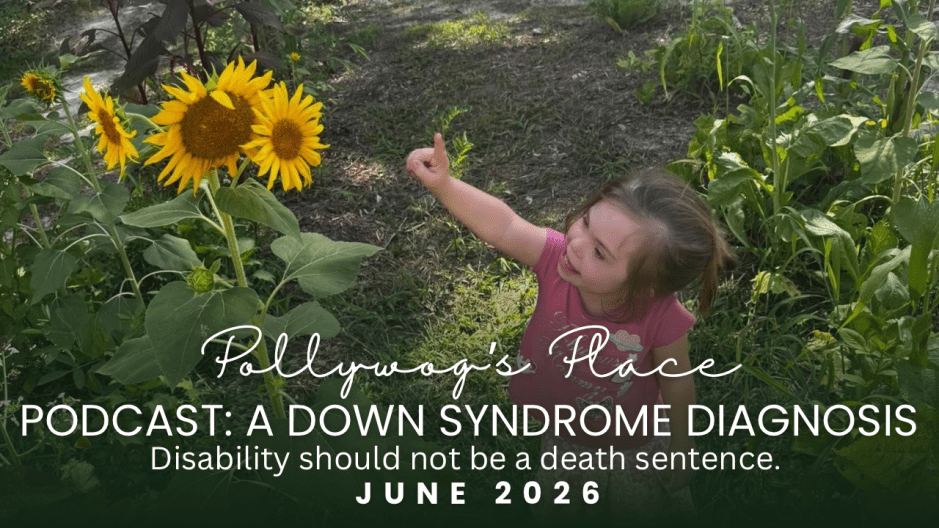
Podcast Episode 01: Down Syndrome shouldn’t be a death sentence

Pip: Welcome to Pollywog’s Place Blog — where the posts are personal, the stakes are real, and nobody is pulling punches.

Mara: Susie at Pollywog’s Place Blog wrote something this week that takes on prenatal diagnosis, medical pressure, and what it actually looks like to say no — repeatedly — when doctors are certain they know better.

Pip: Let’s start with that story.

Down Syndrome Shouldn’t Be a Death Sentence

Mara: The post opens a question that cuts to the bone: when a prenatal diagnosis arrives loaded with worst-case projections, who actually gets to decide what a child’s life is worth?

Pip: The answer, in this case, came appointment after appointment, and it was the same every time. Here’s the line that captures the whole experience: “At every MFM appointment I was asked if I was ready to schedule ‘the procedure’ — I was told that it would be simple, we could try again in a couple of months, and this was just a rare occurrence that we wouldn’t have to worry about happening again.”

Mara: What that means in practice is that the medical framing wasn’t neutral. It was a campaign. The word “procedure” does a lot of work when you use it to describe ending a pregnancy — it flattens the decision into something routine.

Pip: And the pressure didn’t stop at clinical language. Two weeks before the birth, she was told she was being selfish for refusing. That’s not a medical opinion — that’s something else entirely.

Mara: The post is careful to say it isn’t condemning anyone who has faced this choice differently. But it does make a pointed argument: doctors were presenting opinions as facts. They said Shyanne would never walk, would never have a happy life, would be a burden to her other children. Post-birth genetic testing couldn’t even fully confirm the original diagnoses.

Pip: They called it a rare occurrence that wouldn’t happen again — which is a remarkable thing to say about a child who was, at that moment, doing somersaults.

Mara: She frames the core message plainly: “A disability should not be a death sentence for any child who hasn’t even had the chance to live yet.” And she points toward adoption as a real alternative for families who feel unequipped, noting there are communities and support groups that offer something a single genetics appointment simply cannot — time, experience, and people who have actually been there.

Pip: Shyanne defied every projection. She’s described as healthy, active, and, to use the post’s own words, able to light a room.

Mara: The post ends where it began — with faith, and with the insistence that fear of uncertainty is not the same thing as information.


Pip: One post, one family’s experience — and it raises something that stays with you.

Mara: When the data runs out, the question of who decides is still very much open.

You can read the post HERE:
Down Syndrome shouldn’t be a death sentence

Happy Mother’s Day!

Love with Limits: Essential Screen Time Rules for Kids

The title might sound a little contradictory, but I promise that it is possible to show LOVE with limits, especially when it comes to raising children. If we just let our kids run wild all the time, then they may never learn to be the respectful, fair, and caring citizens that we would like them to be.

One way that we do this is with some limits on their electronics. The world is FULL of not-so-nice people and bullies, and it is our job, as parents, to protect our children in whatever ways we can. While not allowing access to screens would prevent a lot of potential issues, we want them to learn to make good choices when it comes to electronics and screen time.

As we learned in our science lesson today, PREVENTION is the number one key to keeping diseases away. This goes for gardening, health, and habits. It is also the best way to PROTECT our children and show them that we LOVE them. Boundaries are an important part of our PREVENTION PLAN. We need them to learn to make responsible decisions even when we aren’t around. We also need them to let us know when there is a problem and if something is making them uncomfortable.

Another thing that our children learn, from early on, is that SCREEN TIME is a PRIVILEGE and if they are not responsible, then it CAN and WILL be taken away! I don’t remind them of the rules, as they have all had plenty of time to learn them at this point. If we see that they have not finished their chores, used more time than allowed, or not followed the rules in one way or another, then they will LOSE their SCREEN TIME for a designated amount of time.

The rules that we have are to ensure that they develop other interests, stay responsible around the house, and keep EVERYONE SAFE! I don’t need to tell you how DANGEROUS the internet can be. We don’t always allow them online, and they are only allowed online with supervision. They generally are not allowed in chats unless a known adult is in the same chat group or right there with them.

Continue reading “Love with Limits: Essential Screen Time Rules for Kids” →

LOVE is More Than a Feeling: Showing GOD’s LOVE Through Action

LOVE is our theme of the month, and we are working on learning ways to show LOVE other than just telling someone that we LOVE them. Our kids have brainstormed some fun and budget-friendly ways to show LOVE for others. We want to learn to create memories without spending a fortune.

Continue reading “LOVE is More Than a Feeling: Showing GOD’s LOVE Through Action” →

Finding Peace Amidst the Noise

There are so many things I could write about, as we have been focusing on PEACE this month in our home. I have noticed ways that we can eliminate things to bring PEACE, and other things that need to be changed. We have had several appointments this month, and something that has struck me is how LOUD this world is.

Continue reading “Finding Peace Amidst the Noise” →